
How to Study for Biology: 9 Methods That Work
Taking a biology course and feeling a little overwhelmed at study time? Biology can be a lot to handle even for the most organized student. The main reason for the overwhelm is the very nature of the subject. As the UNC Writing Center puts it: "Unlike some other disciplines in STEM, biology does not always have a clear set of 'practice problems' or 'formulas' to follow that direct your learning." To excel in Biology, you have to go beyond just memorizing terms. Understanding systems, cellular structure, and a lot of new vocabulary is all part of getting those top grades.
The good news is that if you approach studying for this subject strategically, the results can be rewarding. Effective study methods are key here because Biology is such a layered subject. You have to start at the foundations and work your way out.
This guide walks you through why biology is different from other subjects, the 10 study methods that actually work, the tools that make them easier, a 4-week study plan, common mistakes to avoid, and answers to the questions students ask most often.
Let’s dive in!
TL;DR
- Biology is tougher to study than other subjects because, on top of memorization, it also requires understanding and visualization skills.
- The best study methods combine techniques like active recall, spaced repetition, and concept mapping to help link ideas together.
- Digital tools like AI flashcard generators, PDF summarizers, and tools that incorporate spaced repetition can compress hours of prep into minutes.s
- Cramming is the least effective strategy, especially in biology. Consistent short sessions beat an all-nighter every time.
Why Biology Is Different From Other Subjects
For most students, the struggle with studying for Biology doesn’t come from the material itself, but from the way the material is structured. Three unique features make Biology different.
1. It builds on connected concepts.
If you are studying Biology, you know that every topic touches every other topic. Cellular biology can lead you to genetics, which leads you to evolution, which can then lead to ecology and so on. If you miss one concept, the next one may not make sense to you, making studying harder and less effective.
2. It requires three types of learning at once.
When studying for Biology, you have to memorize complex terms like mitochondria and ribosomes, while at the same time absorbing processes like the Krebs cycle, and being able to visualize the systems in action. Very few subjects require you to master all three at once.
3. The vocabulary is dense.
According to the University of North Carolina Learning Center, a typical intro biology course introduces more new terms than a first-year language class. Vocabulary density is one of the hallmark challenges when studying for Biology.
9 Biology Study Methods That Work
1. Spaced Repetition
Reviewing material at increasing intervals has been shown to help with long-term retention. Spaced repetition works because it forces your brain to retrieve information right before you forget it. You can apply this technique by scheduling what you study at increasing intervals.
Study tip: Learn the phases of mitosis on Monday. Review Tuesday, Friday, the following Wednesday, and again ten days after that.
2. Active Recall Through Flashcards
Simply reading over your notes is not studying. The way to make sure information actually sticks in your brain is to test yourself on the information you want to retain. Flashcards have been around for a long time and are the simplest and most effective way to force retrieval. Every review builds your memory in a way simply reading over material can’t.
Study tip: For every new term you see in a chapter, make a flashcard. On the front, only put the term. On the back: the definition, plus a helpful visual or the term in action to provide context.
3. Concept Mapping
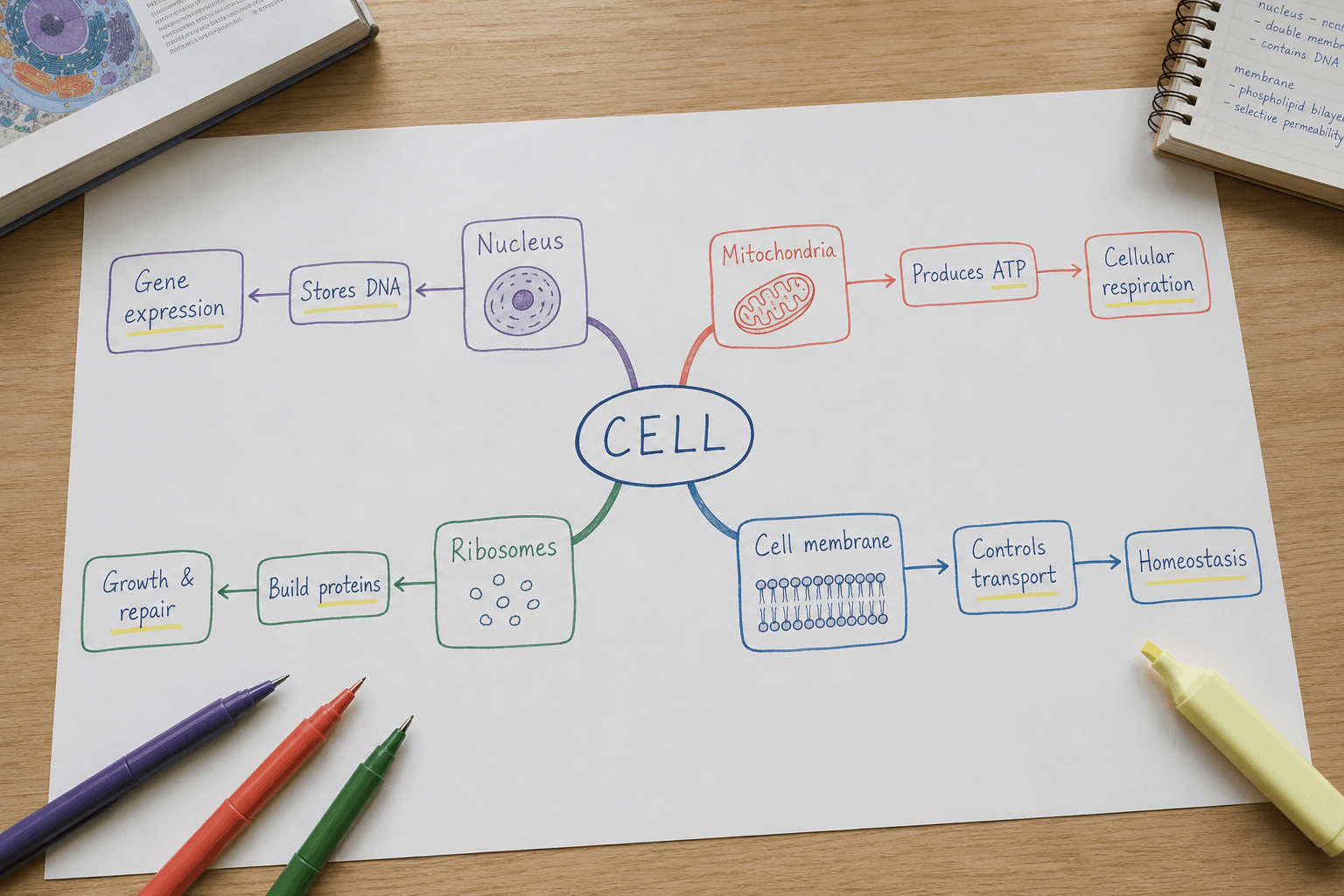
Some people learn better using visuals or diagrams. When it comes to Biology, drawing the connections between ideas as a visual web can be effective precisely because everything you are learning is part of an interconnected system.
Study tip: To try concept mapping, write the word "Cell" in the centre of a blank page. Branch out to organelles. From each organelle, branch to its function. From function, branch to the system it supports. You may need a bigger piece of paper!
4. The Feynman Technique
The Feynman technique asks you to pretend you are teaching a concept to a curious middle schooler. If you fumble or get too complicated in your response, you need to go back and study the section more.
Study Tip: Explain how DNA replication works using only everyday language. You will quickly discover which parts you actually understand and which parts you were just repeating.
5. Draw Diagrams by Hand
Similar to concept mapping, drawing Biological structures from memory forces you to code them into your brain in a way that staring at the same diagram in your textbook can’t match.
Study Tip: After studying the anatomy of a neuron, spend a minute committing the diagram to memory. Then close your book and try to draw it. Check against the original. Fill in the gaps.
6. Practice Questions and Past Exams
Practice exams get you as close to the real thing as you can get without actually writing the exam. The more you practice, the better prepared you will be. Practice exams will build your retrieval muscle and get you acclimated to a testing format.
Study Tip: Try to find past exams for your course. Sometimes your professor will make these available. Pay attention to the format. Are the past exams all multiple choice? Tailor your studying so you are mostly practicing this format.
7. Read Actively, Not Passively
Active reading involves more than just skimming material and highlighting important sections. The key to active reading is interacting with the material you are reading. It's a good idea to have a pen and paper nearby to jot down some notes and write down.
Study Tip: Before reading a chapter, jot down three questions you expect the chapter to answer, then read to find them.
8. Study in Short, Focused Sessions
Shorter study sessions with regular breaks in between work are better than a three-hour cramming marathon. Your brain needs time to consolidate information,n and it does this during rest. This is the reason why cramming is not a very effective study strategy.
Study Tip: Study for 45 minutes, take a 15-minute walk, then study for another 45 minutes. Repeat rather than push through fatigue.
9. Form or Join a Study Group
Study groups are a natural way to discuss your thinking and ideas out loud, which can help you understand them better and also expose gaps in your knowledge.
Study tip: Meet weekly with three or four classmates and rotate who leads.
Best Digital Tools That Make Biology Easier
The right study tools can compress hours of prep into minutes. Here are a few to consider before your next big test:
AI flashcard generators
AI flashcard generators can turn your pile of notes and textbook chapters into a fully organized digital deck. You can also create flashcards as you go, or create study flashcards from existing cards or other files you have accumulated.
Quiz generators
Quiz generators can help you turn any chapter into a set of practice questions you can use to prepare for upcoming assessments.
PDF summarizers
Students accumulate lots of useful PDFs. A PDF-to-flashcard tool can help you turn entire chapters into study decks automatically.
Spaced repetition software
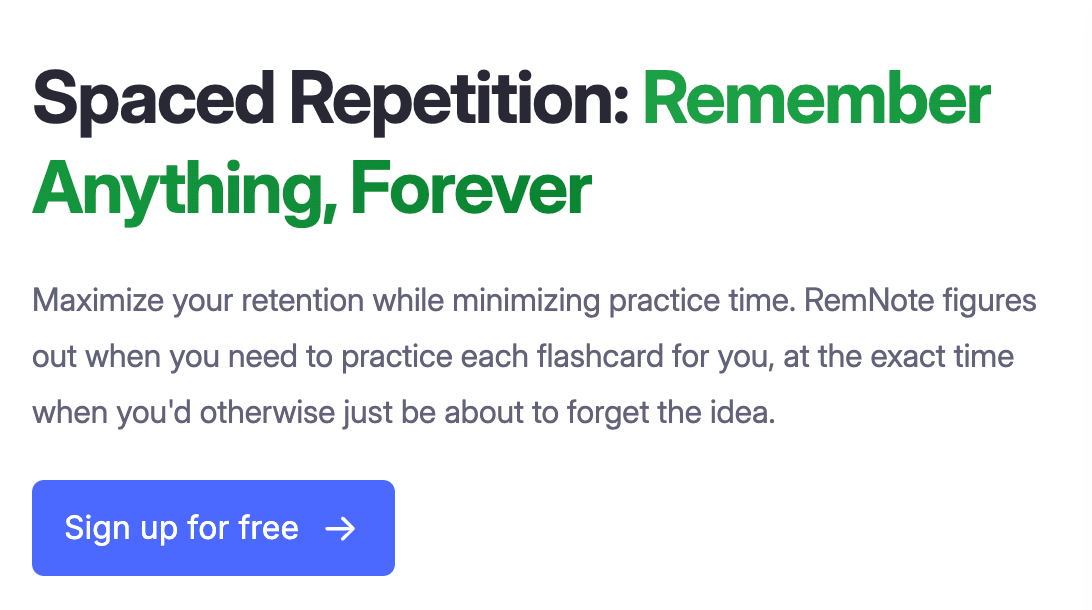
Spaced repetition is a great way to strategically schedule your reviews for maximum retention. Tools that have this functionality built in can help you retain information faster, cutting down on your study time.
Annotation tools
PDF annotation and PPT annotation let you highlight and question the material directly, and an AI note taker captures lectures you can review later.
Our roundups of the Best AI study tools, Best flashcard makers, and Best Quizlet alternatives cover the major tools side by side. Pre-med students should also check our guide to the Best AI tools for medical students. Pre-built study decks cover most intro biology topics too.
How to Prepare for Your Biology Test
Most students wait until the last minute to start studying. The not-so-secret secret to test prep is starting earlier than you think is reasonable and building a study habit.
Begin your prep at least two weeks in advance. Chunk the material into manageable daily sections and alternate between absorbing new content and reviewing what you’ve already covered. Practice tests are a great way to prepare as you get closer to the date of your assessment.
When you are faced with a test or exam question, approach it strategically. For example, on multiple-choice questions, first eliminate what you know is wrong and narrow down your options before choosing your final answer. On short answer questions, include specific examples to illustrate your knowledge and understanding.
A good night's sleep is an underrated exam prep technique. Your brain does most of its memory consolidation during sleep, so cramming all night is actually one of the worst things you can do for retention. Work with your biology when studying for biology!
4 Week Biology Study Roadmap
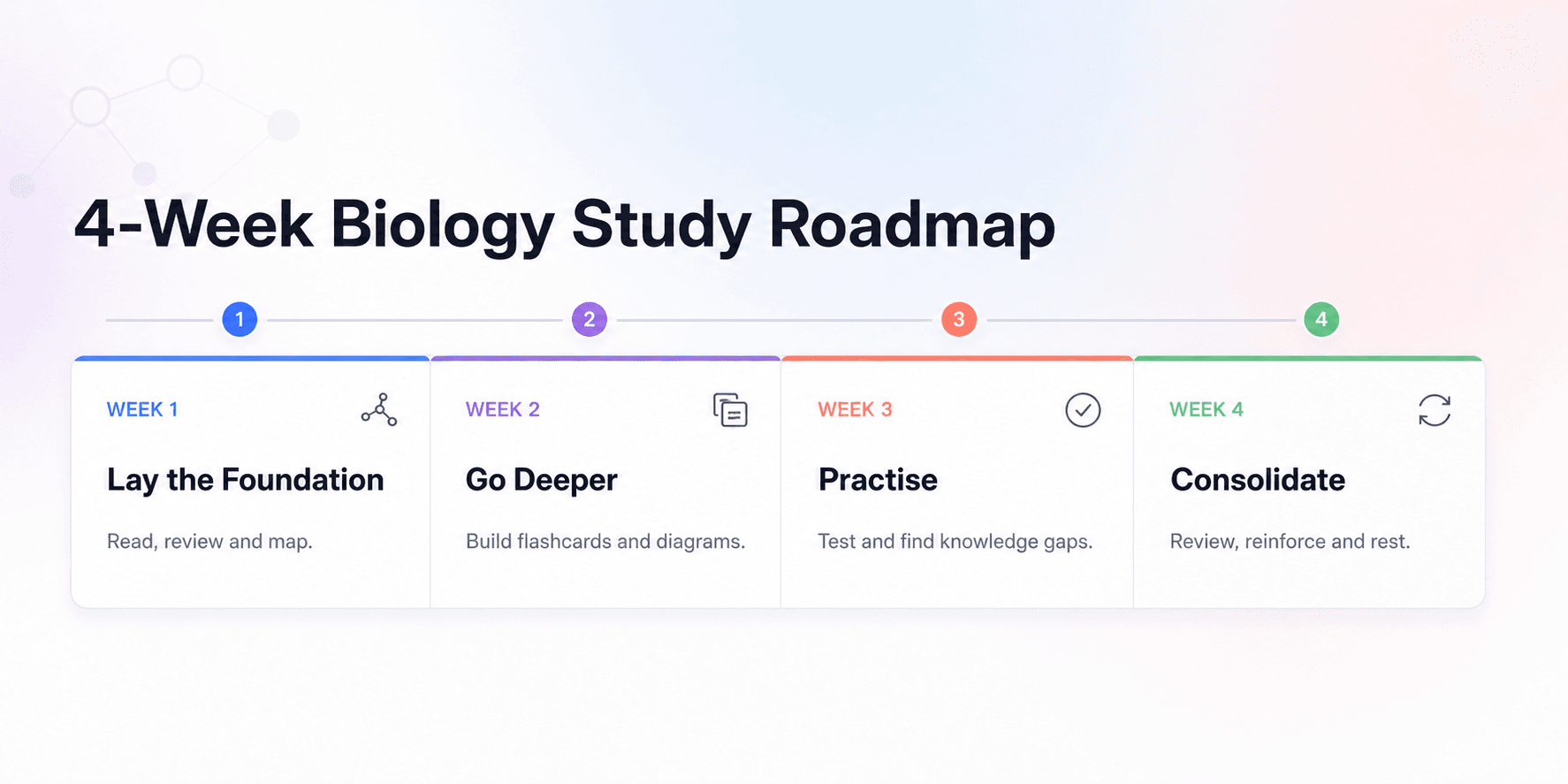
Week 1: Lay The Foundation
Begin by reading through the chapters you know will be covered on the exam. Skim first, then zoom into sections for more details. If you are a visual learner, making concept maps of the main topics is a great way to add structure to your learning and understand how different materials fit together. Have a pen and paper handy as you are skimming and reviewing your study materials.
Week 2: Go Deeper
Week two is the optimal time to make study decks for your materials. Create flashcards for every key term and include diagrams to help you retain and contextualize information as you study.
Week 3: Practice
The sooner you can get exposed to real exam questions, the better. Practice tests and past exams can help you identify where you have gaps in knowledge or need to go a little deeper in your understanding. A study group is a great way to expose yourself to more practice scenarios, and they can also help you stay accountable.
Week 4: Consolidate
Once you’ve fed your brain all the content it needs to absorb, you need to get strategic about how you train it. Use spaced repetition techniques to review everything. Focus on areas you found hard or confusing, and don’t forget to sleep.
Common Mistakes to Avoid
- Waiting until the week of the exam to begin preparing
- Passively rereading notes instead of testing yourself
- Pure memorization without understanding the concepts
- Studying in long sessions instead of chunking the work
FAQs
How do you take notes for biology?
Focus on the structure of the information you are trying to capture instead of on writing down as many details as possible. Use a variety of formats, headings, and diagrams,s and leave space to add connections or additional notes later. Clean up and organize your notes soon after you take them.
What do you learn in biology?
Introductory biology covers cells, genetics, evolution, ecology, and often anatomy or physiology. Higher-level courses go deeper into specific areas: molecular biology, microbiology, botany, or human biology.
How do you study for a biology test?
The key to success in testing is preparation. Give yourself plenty of time to absorb the material, create study tools like flashcards, and review. This can take several weeks depending on the size and complexity of your assessment. Your brain needs time to integrate new and complex knowledge. The earlier you start, the better.

