
8 Best AI Tools for Medical Students in 2026

The United States Medical Licensing Examination, which every American medical student must pass before they can begin residency, is ranked among the ten most difficult exams in the world.
Medicine is, by any measure, one of the most difficult degrees you can commit to. No matter how many hours you put in, there is always more to learn and retain.
It’s therefore necessary for medical students to study smart.
So I turned to the internet in search of AI tools that could help with medical education. I spent time individually testing every tool I could find to see what I liked about it, what I felt was missing, what it was best for, etc.
In this article, I review the 8 best AI tools for medical students I found, each of which is broken down into its key features, pros, cons, and pricing details.
TL;DR
| Tool | Best for | Standout Feature | Free Plan | Starting price |
| RemNote | Integrated note-taking and flashcards | Combines your notes, flashcards, and PDF annotations in one place | Yes | $10/month (when billed monthly) |
| Amboss AI | USMLE / board exam prep | LiSA AI chat is exclusively trained on clinical data | No | $19.99/month |
| Geeky Medics AI | OSCE and clinical skills | 900+ dynamic virtual patients | Yes | $34.99/year |
| OpenEvidence | Clinical research | AI search results from NEJM, JAMA, Cochrane, NCCN, FDA, and CDC sources | Yes | Free (ad-supported) |
| Neural Consult | Curriculum-adaptive self-study | Turns your lecture slides into flashcards, questions, and patient cases | Yes | $9.99/month |
| Studley | On-the-go active recall | AI audio lessons from your study source to listen to from anywhere | Yes | $3.74/week |
| MindGrasp | Organizing study material | AI image analysis for anatomy, histology, radiology, ECGs, etc | Yes | $5.99/month |
| Arkangel AI | Bedside clinical support | Routes your search queries into research, diagnostic, treatment, or general workflows | No | $20/month |
Challenges faced by medical students in traditional learning & how AI can help
Medical students need to retain a relentless stream of information from multiple different organ systems sustained over years. If you fall behind, even for a week, the compounding effect of the volume of this information gets too overwhelming to manage.
In clinical years, you also need active skill-building in terms of communicating with patients and performing examinations. Hospital exposure is great for such learning, but it's pretty limited. You need to practice it as much as you can, particularly when you're close to your exam.
We're fortunate enough to be living in times when AI is good enough to address both these issues.
AI flashcard tools with algorithms that run on active recall and spaced repetition principles target your knowledge retention. And AI-based simulation tools can be used to recreate patient encounters for OSCE-style practical learning.
8 Best AI tools for medical students in 2026
Here’s a detailed insight into the best AI tools for medical students I found.
1. RemNote
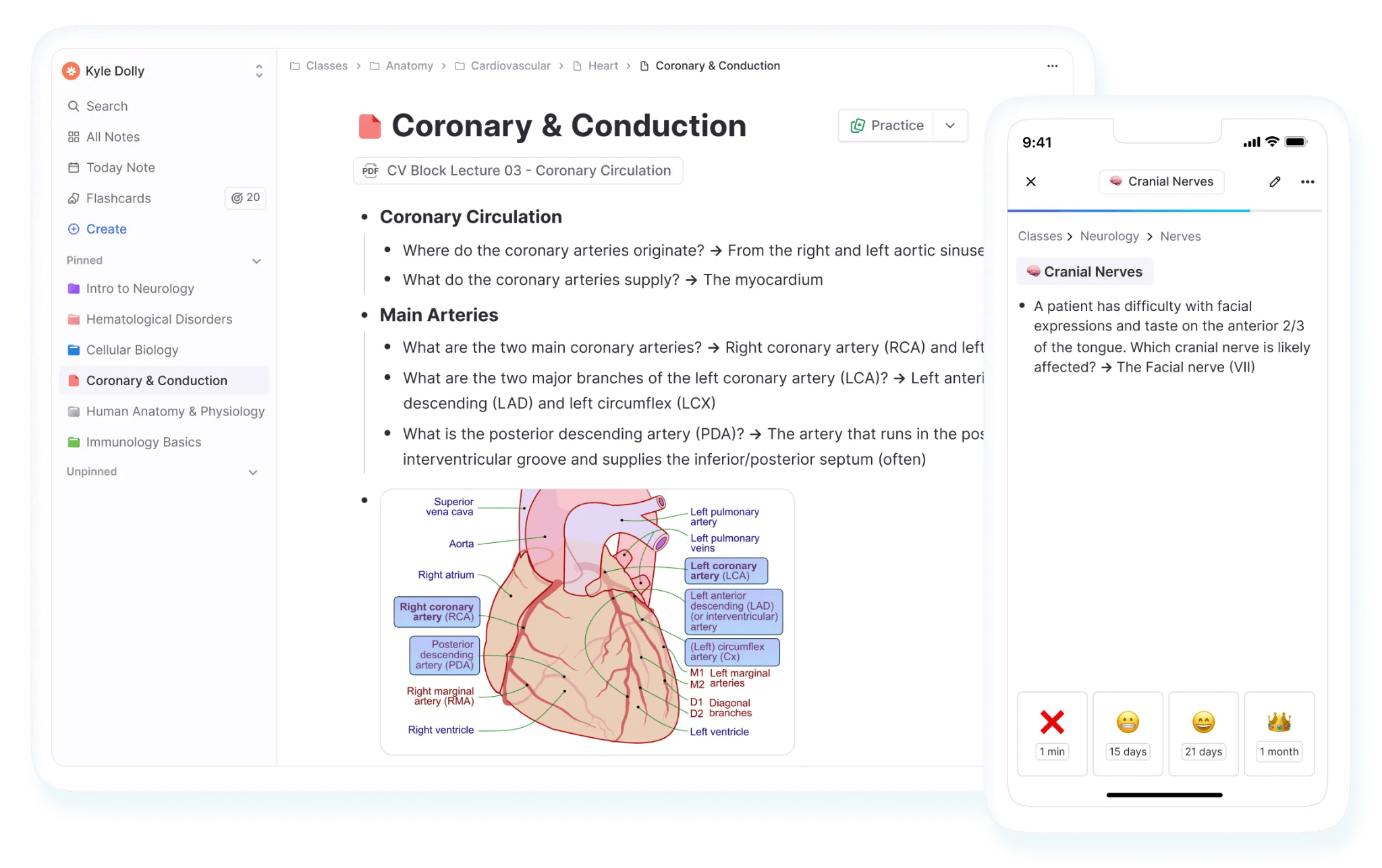
RemNote is made to integrate all your note-taking and flashcards in one space, synced across every device you own.
It was founded in 2020 at MIT by Martin Schneider and Moritz Wallawitsch, who were both frustrated by having to switch between apps while studying.
What makes RemNote especially useful for medical students is that your flashcards live inside the same document as your notes, so you can skip the hours of rewriting lecture content into a separate Anki deck.
The platform is loved by medical students all over the world and serves over 1 million students.
Key Features
- The notes can be nested to create hierarchies. You can add media and links to your notes, too
- You can turn your notes into personalized flashcards using AI
- Notes and flashcards on similar topics can be clustered together using simple double-bracket syntax
- It lets you create image-occlusion flashcards for anatomy topics
- You can upload your PDFs and annotate them with highlights and drawings as you study
Pros
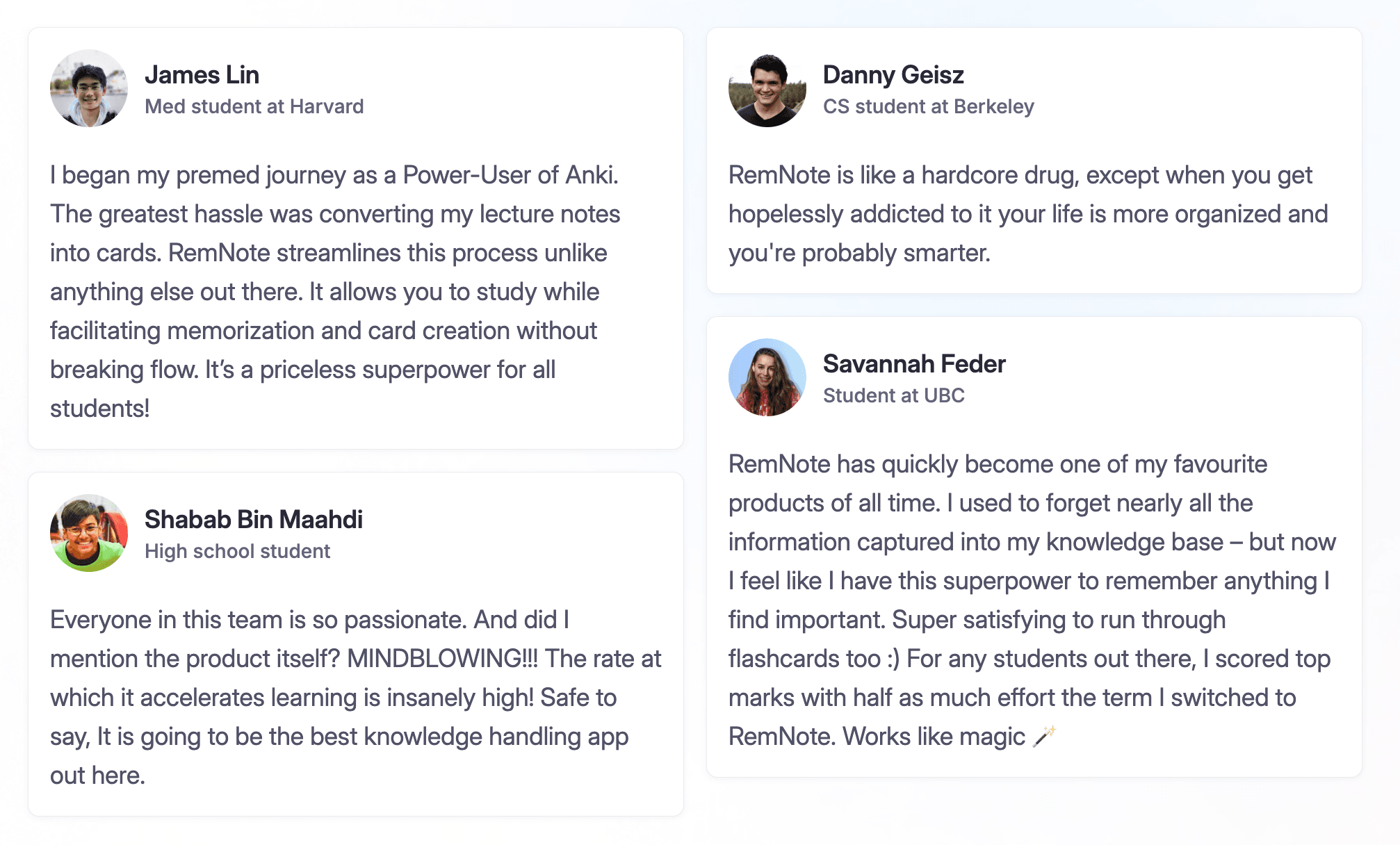
- RemNote works like Notion, Anki, and Quizlet, all in one place at once
- The spaced repetition algorithm is on par with that of Anki
- Flashcards are linked with original source material, unlike Anki, where they feel like disconnected chunks with no context
- Offline mode and mobile app make studying in clinical settings pretty easy
Cons
- AI features are locked behind paid plans
- RemNote is one of the best AI tools for medical students when studying individually, but it doesn’t have team-based collaboration tools
Pricing
RemNote has a generous free plan that gives you unlimited notes and flashcard creation. The paid plans are:
- Pro for $8/month billed annually that adds PDF annotation and AI features
- Pro with AI for $18/month with AI grading, chat, image-to-text features, and 20,000 AI credits
RemNote has a 25% education discount for students, faculty, and staff with a verifiable academic email.
2. Amboss AI
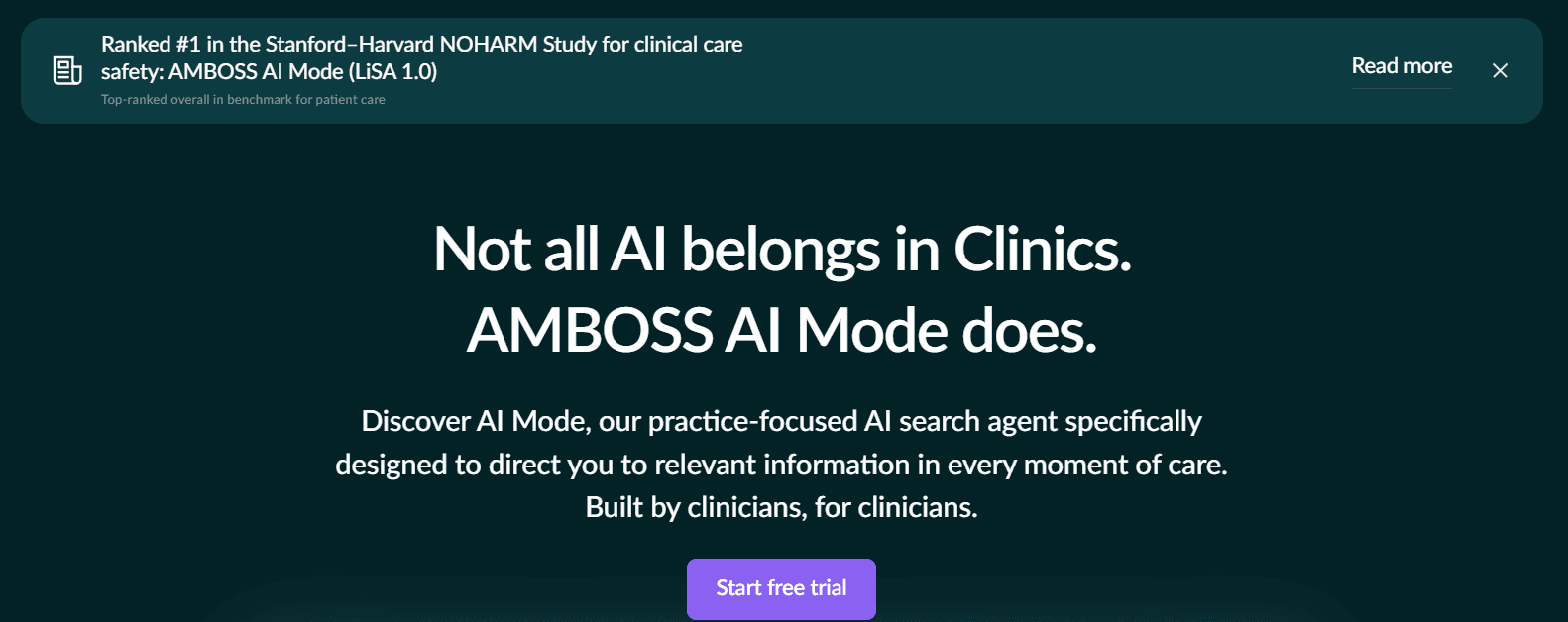
Amboss is long known for its QBank and Medical Library among students, but its AI clinical mode (LiSA 1.0) has also topped all charts ever since the launch. It was ranked #1 in the Stanford–Harvard study for clinical care safety among 31 models tested.
The AI mode is a search agent that only extracts its information from clinical US guidelines, medical literature, drug databases, and Amboss’s own medical library.
Key Features
- The responses to your questions on the AI model are linked to relevant articles and QBank sessions
- The medical library consists of over 1,400 evidence-based, high-yield articles
- Amboss has 13,900+ board-style questions for USMLE Step 1, Step 2 CK, and Step 3, COMLEX, and NBME Shelf exams
- It gives you an accurate estimate of the passing likelihood and score prediction for Step 1, Step 2 CK, and Step 3
- Amboss has an Anki add-on integration
- Amboss Assistants are beta AI tools within the medical library, e.g., a Clinical Case Simulator, a MediCoach, a Learn by Teaching tool, and the Explain Simpler tool
Pros
- Equally useful for exam prep and for clinical practice to look up differentials and check drug dosages at the bedside
- LiSA is a reliable AI chat agent that doesn’t hallucinate
- The Assistants are great for oral exams and OSCE prep if you don’t have a study partner
Cons
- Amboss Assistants are still in beta
- Amboss AI works best on its own medical library content. You can’t use the assistants for your external notes
- The AI features require a full subscription to be unlocked
Pricing
Amboss has a base membership plus an optional Qbank upgrade. The membership costs $19.99/month, and Qbank packages are priced at 1, 3, 6, or 12-month tiers.
It offers a 5-day trial for all users to test out the tool.
3. Geeky Medics AI
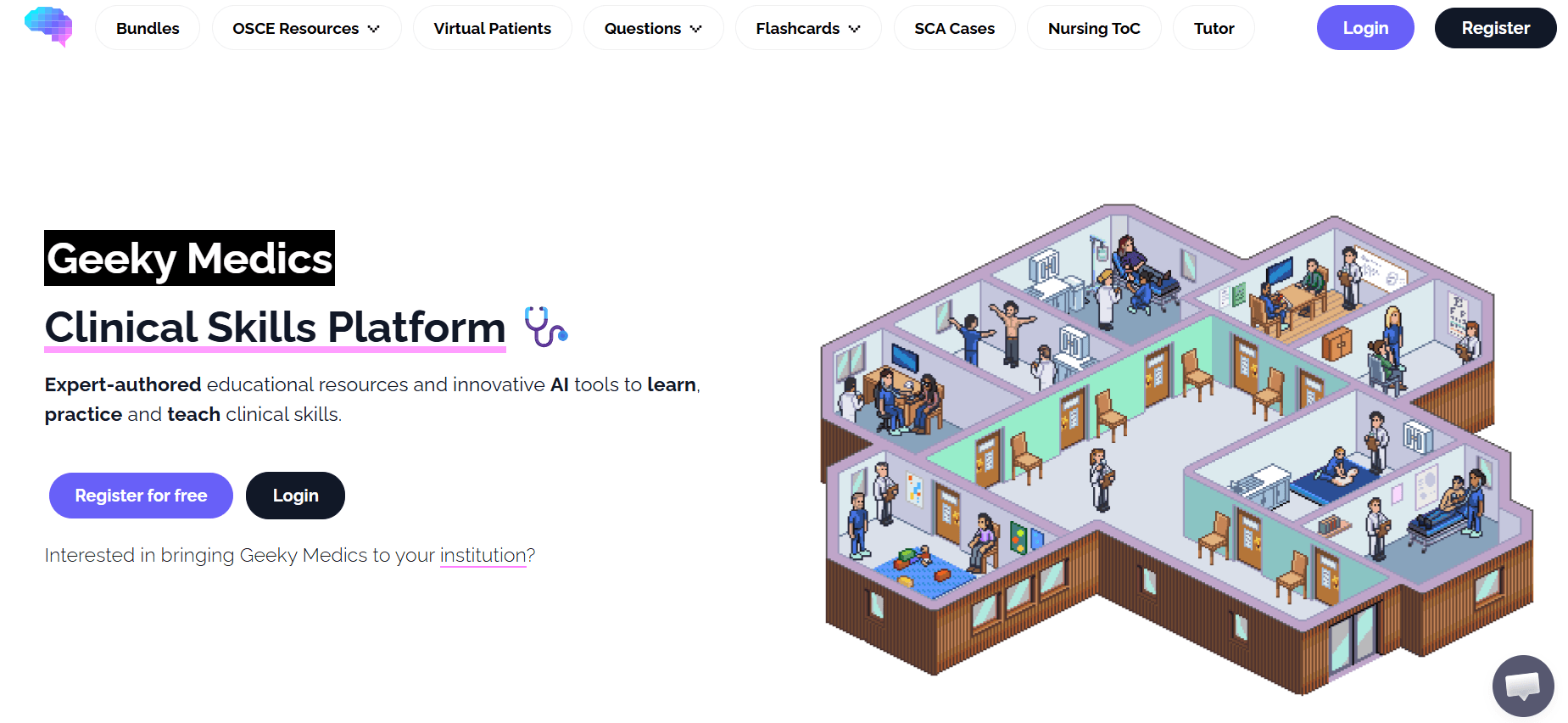
Geeky Medics targets your clinical learning over content coverage. Its flagship AI feature, SimChat, is more of a simulation environment to rehearse your real clinical encounters and receive examiner-style feedback for OSCEs. SimChat developed virtual patients using OpenAI's GPT-3.5 and GPT-4 LLMs.
Key Features
- You can interact with 900+ virtual patients, each of which will respond to your questions dynamically
- An AI examiner assesses your interaction with virtual patients and grades you as per the OSCE checklist rubric
- The real-time voice mode allows natural conversations
- Geeky Medics also gives you a personal AI tutor with an integrated question bank, flashcards, and OSCE station performance data
- You can create your own virtual patients
Pros
- SimChat is one of the few OSCE prep tools out there that removes your dependency on study partners
- There’s a comprehensive volume of clinical cases
- Geeky Medics’ virtual patients have been researched in a peer-reviewed study and found to be close to real-world patient encounters
Cons
- The AI is purpose-built for OSCEs only. It won’t help you if you are in your pre-clinical years
- The platform is built around UK clinical standards. Some guidelines may be different in different regions
Pricing
Geeky Medics has a free-tier-plus-subscription model.
On the free account, you can practice up to 50 OSCE stations. The four primary bundles are:
- Knowledge bundle for US$34.99/year
- Data interpretation bundle for US$39.99/year
- Clinical skills bundle for US$49.99/year
- Everything Bundle at US$69.99/year, which adds question banks, flashcards, and knowledge resources to the clinical skills bundle
4. OpenEvidence
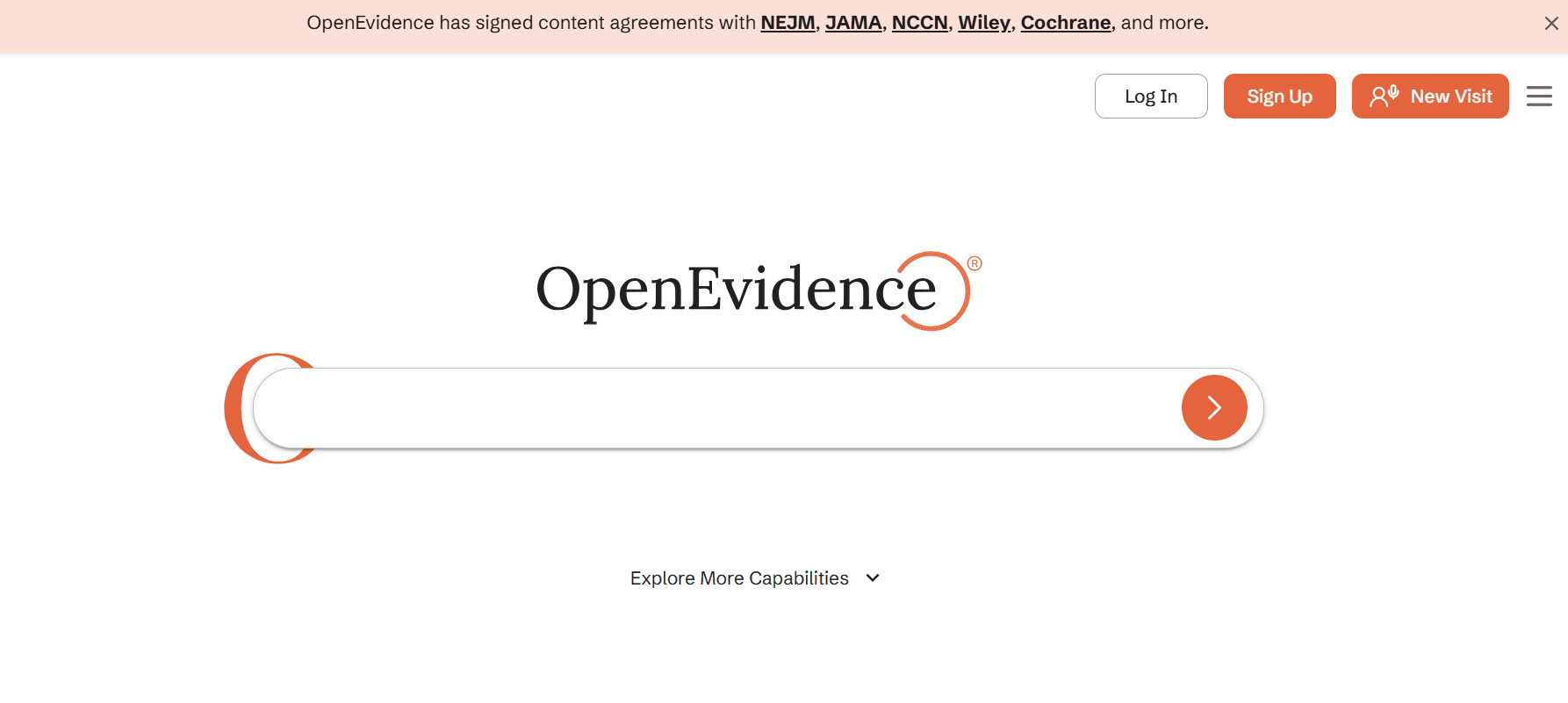
OpenEvidence is a research support AI tool exclusively built on peer-reviewed medical literature coming from authoritative journals.
OpenEvidence is the official AI partner of NEJM, JAMA, and all eleven JAMA specialty journals, Cochrane Systematic Reviews, and NCCN. It also has partnerships with ACC, ADA, AAFP, ACEP, AAOS, FDA, and CDC sources.
Key Features
- The Quick Consult feature gives you state-of-the-art AI search algorithms to find the exact guidelines and papers specific to your research question
- Deep Consult is an AI research agent. It uses reasoning models to connect relevant topics
- OpenEvidence has recently developed the USMLE Explanation Model, a medical education AI that can teach you the reasoning behind each answer
- Every clinical claim in OpenEvidence responses is linked to its primary source
- Your feed includes “Featured,” “Trending,” and “New Evidence” tabs filtered by medical specialty
Pros
- It was the first AI in history to achieve a perfect 100% score on the USMLE
- It’s available on native iOS and Android apps
- OpenEvidence is free for verified healthcare professionals
Cons
- OpenEvidence is primarily for students in clinical years and practising physicians, rather than M1 or M2 students
- It does not have learning tools like flashcards or a Qbank
- Although free to use, you’ll see pharmaceutical and healthcare company advertisements on the app
Pricing
OpenEvidence is entirely free for students and healthcare professionals with institutional emails. It is supported by ads rather than subscriptions, so no paid tiers exist.
5. Neural Consult
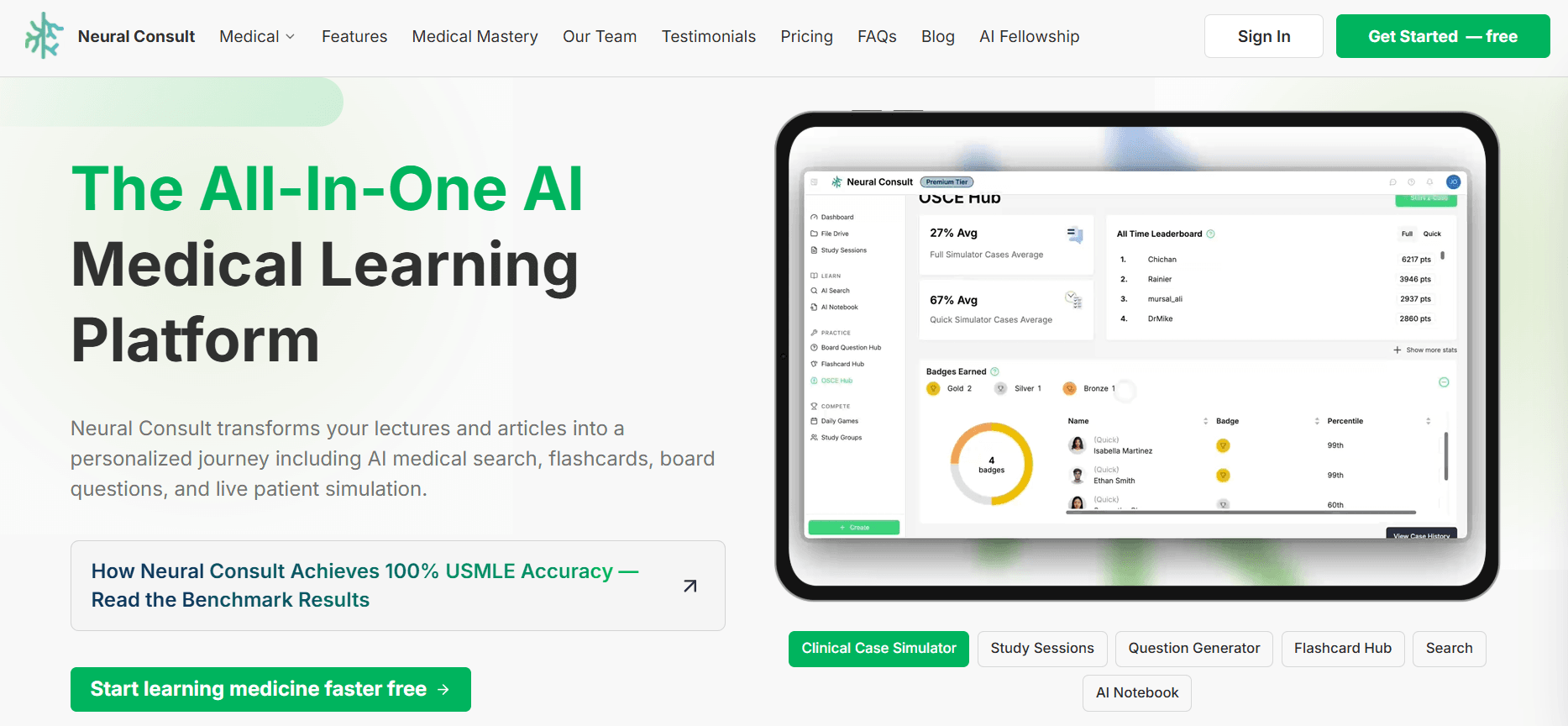
Neural Consult is another AI medical learning platform that creates a personalised learning environment from the content you feed it.
So it doesn’t have a fixed content library like Amboss. But if you put your lecture slides and books in there, you’ll get custom summaries, questions, and flashcards tailored to your institute’s preferred study material.
It is developed under Dendritic Health AI, which has developed multiple other healthcare education tools. It has a campus-based AI Fellow Program through which medical students act as Neural Consult ambassadors at their institutions.
Key Features
- It creates a searchable database of your study material with all files cited
- You can run a learning sequence with an AI summary, an AI podcast, flashcards, practice questions, and custom AI patient cases
- Your flashcards can be exported to Anki
- It generates board-style questions for USMLE, UKMLE, MCCQE, NEETPG, PANCE, and NCLEX
- GLIA is an AI Tutor and Copilot within Neural Consult that explains tough question choices and guides you through clinical cases
Pros
- It is the most curriculum-adaptive AI study tool
- GLIA eliminates the need to have a study partner at all times
- You go from lecture slides to summary, flashcards, questions, and patient encounters, all within one app
Cons
- Neural consult works best with text-heavy slides. The AI may get confused with visual, diagram-based content upload
- It does not have its own clinician-validated knowledge base
- The clinical case simulator is weaker than that of Geeky Medics
Pricing
There’s a limited free plan with which you can try out all the features of Neural Consult. The paid plans are:
- Monthly pro for $9.99 per month
- Annual pro at $6.63 /month billed annually
6. Studley
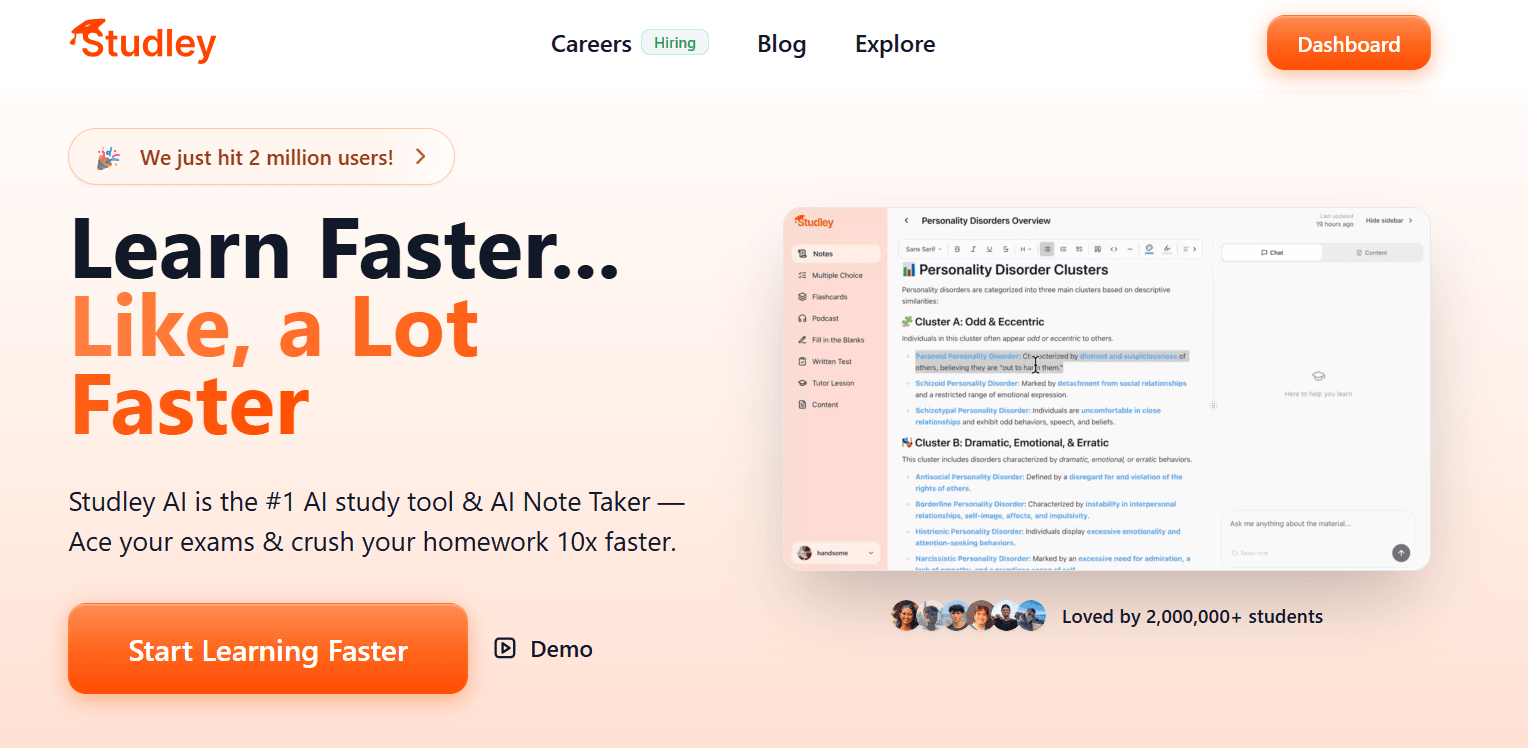
Studley is more of a general-purpose AI study platform. It converts passive study resources, i.e., lecture notes, PDFs, YouTube videos, articles, audio recordings, or photographs of textbook pages into active ones (flashcards, quizzes, fill-in-the-blank tests, AI-tutored lessons, etc).
Studley blew up through viral TikTok videos. It is not one of the clinician-founded tools we have on this list, but many medical students genuinely report it to be useful.
Key Features
- You can upload your study material to get flashcards, multiple-choice questions, fill-in-the-blank exercises, and practice tests
- Studley has a built-in AI tutor to answer questions about the material you upload
- It generates AI audio lessons that you can listen to on the go
- It allows you to snap a photo of a question and receive an instant answer
- You can submit your written work and have an AI grade it and give you feedback
Pros
- The platform syncs on the web, iOS, and Android
- Studley's audio lessons are great for on-the-go learning
- The AI chat gives you answers for the material you have uploaded
- The free tier requires no institutional verification
Cons
- Studley has no peer-reviewed clinical content base since it is not particularly built for medicine
- Some user reviews have highlighted issues like notes being cut off mid-chapter or error messages appearing when uploading the material
- The free tier is limited to one study set per day
Pricing
Besides a free plan that allows you to create one study set per day, you can sign up for the paid plans with unlimited features for:
- $3.74/week billed monthly
- $1.88/week billed annually
7. MindGrasp
MindGrasp was founded in 2021 at the University of Maryland, and it claims over 5 million users as of today. Similar to Studley, it uses your educational content to turn it into notes, summaries, flashcards, and quizzes.
It's best used to hand off the busywork of organizing your study material to AI. MindGrasp achieved ESSA (Every Student Succeeds Act) Level IV certification in 2024.
Key Features
- It converts any uploaded material into structured notes and scannable summaries
- It also auto-generates flashcards and quizzes from your study material
- You can ask MindGrasp AI Tutor any question about the content you've uploaded. The AI assistant can be toggled to search Google Scholar.
- MindGrasp tracks your learning progress for each study session
- Image Analysis with AI works great for anatomical diagrams, histology slides, and radiology
Pros
- MindGrasp’s Chrome extension pulls content from Canvas and Blackboard
- It supports over 30 languages
- It syncs on the web, desktop app, iOS, and Android
- MindGrasp’s user interface is very easy to use
Cons
- Multiple users report billing issues after cancellation of their MindGrasp subscription
- The free trial is only 4 days long and requires credit card details.
- MindGrasp does not work offline.
Pricing
MindGrasp has a 4-day free plan with a tiered subscription model.
- The Basic Plan costs $5.99 per month (or $71.88 per year)
- The Scholar Plan is for $8.99 per month (or $107.88 per year)
- The Premium Plan costs $10.99 per month (or $131.88 per year)
8. Arkangel AI
Arkangel AI is purpose-built for healthcare professionals to be used in hospital settings. It is a conversational agent that answers clinical questions based on research-backed data. It is the perfect tool to bridge the gap between textbooks and real-world clinical reasoning.
Key Features
- Arkangel AI reviews patient records and highlights the priority findings, one of the best AI tools' features for medical students struggling to interpret charts
- MedSearch is Arkangel AI's flagship clinical search engine for clinical questions
- Arkangel AI's system contains five different LLMs
- It classifies your queries into one of the four workflows:
- Clinical research questions that use the PubMed API
- Diagnostic questions, which use the Google API to get answers from clinical practice guidelines
- Treatment questions
- General information questions
Pros
- The system works in English, Spanish, and Portuguese
- Arkangel AI app is available on Google Play and the Apple App Store
- Arkangel has its own hands-on curriculum to help users learn how to use AI for clinical purposes
- Clinically trained AI assistant
Cons
- Arkangel AI's regular mode was less reliable when compared with OpenEvidence
- Arkangel AI does not generate flashcards, quizzes, or auto-notes
Pricing
Arkangel AI has an individual plan priced at $20/month and a team plan for $44/user/month. It also provides custom offers to large institutions.
What is the One Tool That Every Medical Student Should Try?
After I tested all 8 tools individually, I believe many AI tools are purpose-built to streamline one aspect of medical education.
OpenEvidence, for example, is great for research, Geeky Medics is perfect for OSCE prep, and Amboss AI is your gold standard for a board-style question bank.
However, RemNote is that one platform that genuinely replaces your Anki deck, your Notion notebook, your PDF annotator, and the need for a separate AI chat to ask questions.
Its spaced repetition algorithm is on par with Anki and is more structurally aligned with your study material.
It fits the studying needs of both pre-clinical and clinical students, since it helps you build your knowledge base and also retain what you see on your rounds.
You can try RemNote for your next study session for free and see the difference yourself.
FAQs
Which AI is best for a medical student?
RemNote is by far the best AI tool for medical students since all of its features are made for active learning. The algorithm it runs its flashcards on is exactly what Anki uses, but with a much more engaging interface.
What is the best AI for medical use?
For use within clinical settings, Arkangel AI and OpenEvidence are one-of-a-kind tools. Arkangel helps you stay updated with each patient's chart at all times, and OpenEvidence answers your clinical questions with evidence-based sources, so it is highly reliable.
Is Gemini or ChatGPT better for medical questions?
Frankly, neither ChatGPT nor Gemini should be used for medical questions because neither of them is purpose-built for medicine. Many other tools in our list have their dedicated AI chat tools that are more reliable than ChatGPT and Gemini since they are trained on clinical data.

