
What is Spaced Repetition for Learning? A Guide

Research says that you usually forget about 70% of new information within just one day of learning it. That’s just how our brains work by design. If we don’t put active effort into retaining that information, we lose up to 90% of it after a week.
But then, how do you still remember most of the multiplication tables from 1 to 9? Because your technique of memorizing them was different. Had you studied other things through the same technique, you’d also remember them to this day.
What was special about that technique, you might ask? Nothing rocket science. You just practiced them multiple times over a span of period until they became permanent memory.
You can still study things that way. The technique is called spaced repetition. Don’t let that name scare you away. The technique is actually quite simple, as you’ll learn in this article.
We’ll walk you through an overview of the spaced repetition method, its benefits, and things you can and cannot learn with it.
At the end, you’ll also learn about the best spaced repetition app that lets you study things through the spaced repetition method using flashcards.
What is spaced repetition?
Spaced repetition is a learning technique that fixes the issue of long-term information retention persistent in traditional learning methods.
The concept was first explored by German psychologist Hermann Ebbinghaus in the 1880s. His work showed that not only does memory decay rapidly without review, but that reviewing material at spaced intervals could significantly slow that decay down.
The technique asks you to revisit new information multiple times. And each one of those visits has to be paid at a strategic time. You cannot just time those sessions one after another in a row. No. Each subsequent session has to come after a longer wait than before.
The rule of thumb for timing the next session is to figure out when you're about to forget the information from the previous session. You have to time the next session right before that moment.
A spaced repetition example
Let’s say you have to memorize the multiplication table of a number. In the first session, you just read it a few times. Then you try to recall it after some time, say 24 hours later. It’s very likely you might not remember anything, or you might have a very rough memory of it.
That’s when you start the second session. Recall what you can and see the answers to what you can’t recall. Then wait a little longer than before and do the same.
Keep repeating this cycle of wait + session, but each time the wait should be longer. There will come a time when you will have memorized the thing for a long time or even permanently.
From that point, your pace of forgetting that thing will slow down significantly. You won't need to review that specific fact for months or maybe even years because it is firmly stored in your mind.
That’s because these sessions and their strategic timing push information into your long-term memory. The scientific phenomenon responsible for this is called neural consolidation. You can read more about it in our Spaced Repetition Vs Traditional Study article.
Why is spaced repetition good for learning?
Our brain needs repeated reminders that a piece of information is important and must not be forgotten. Going over things only once last night before the exam, as most of us commonly do, doesn’t achieve that. This is why you’ve forgotten most of the things on the exam day.
The spaced repetition technique leverages this simple fact. It makes you go over the study materials again and again at the perfect time to ensure your brain thinks that content is important.
Let’s show you more benefits of this technique over the study habits most of us grew up with.
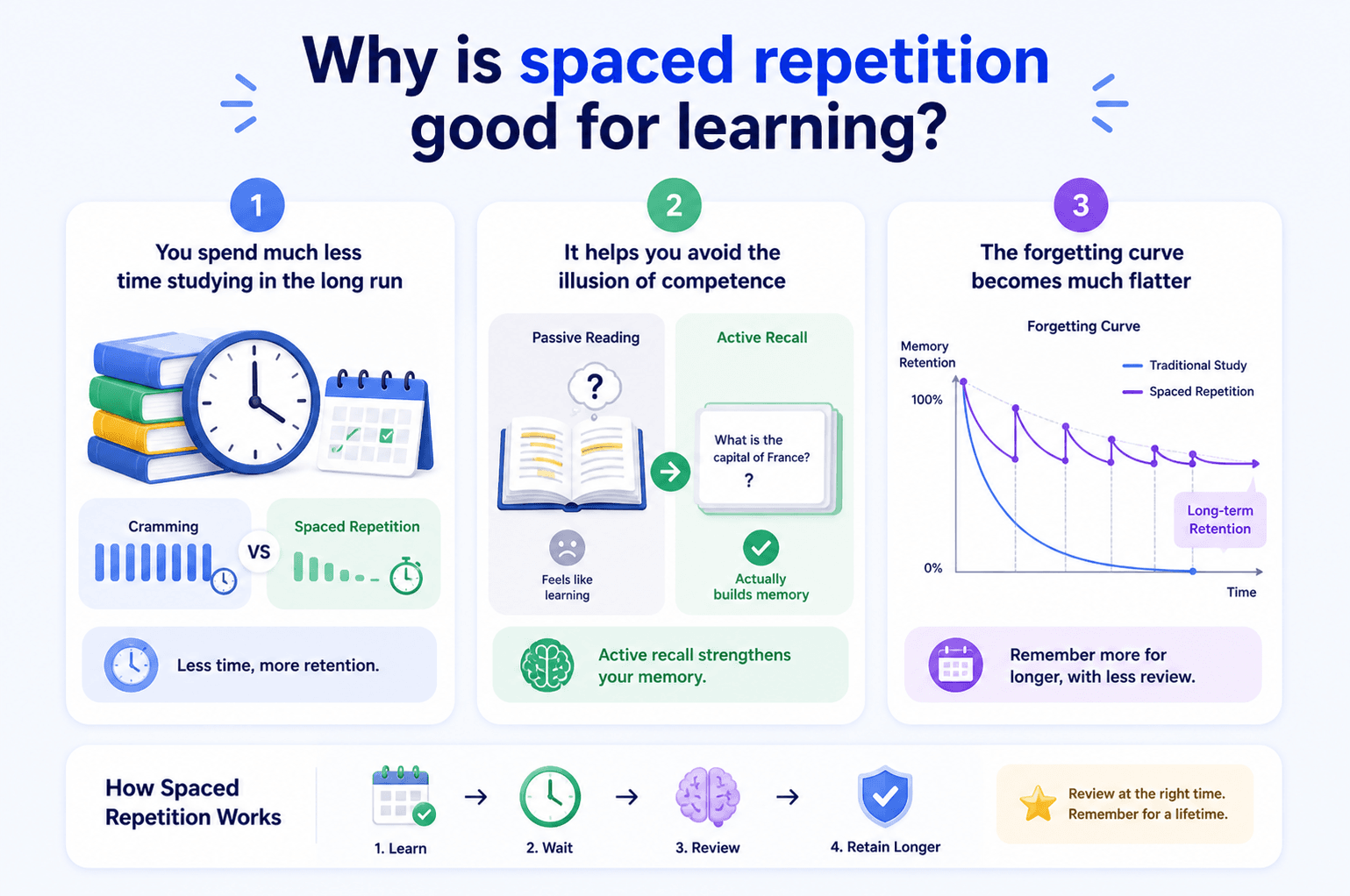
1. You spend much less time studying in the long run
The spaced repetition technique requires you to start studying early. You also need to study across multiple days. This all might feel like more work than pulling an all-nighter before the exam day.
But if you sit down to do the math, you’ll see that cramming everything in a night takes more time in total. And most of that effort goes to waste.
You spend hours and hours in a row trying to learn a thing, but your brain stops recording new information after a while. Once your brain is exhausted, you’re just passively reading things, not memorizing anything.
On the other hand, spaced repetition sessions are scheduled only when you’re about to forget things. And even in those sessions, you only study the part(s) you were about to forget, not the whole thing.
Do these sessions over a few months, and you’ll only need a few minutes of revision before the exam.
2. It helps you avoid the illusion of competence
In a traditional study, you read your notes a few times, highlight parts of them, and think you’ve learned the material. But that’s an illusion.
Passively reading things multiple times only makes you familiar with the material. And being familiar with something doesn’t mean you have it memorized and can recall it whenever needed.
To actually memorize things, you need to study them using active recall. In simple words, you have to produce the answer from your own memory without looking at the notes first.
The mental struggle you will put into recalling the answer will etch that thing firmer into your memory.
3. The forgetting curve becomes much flatter
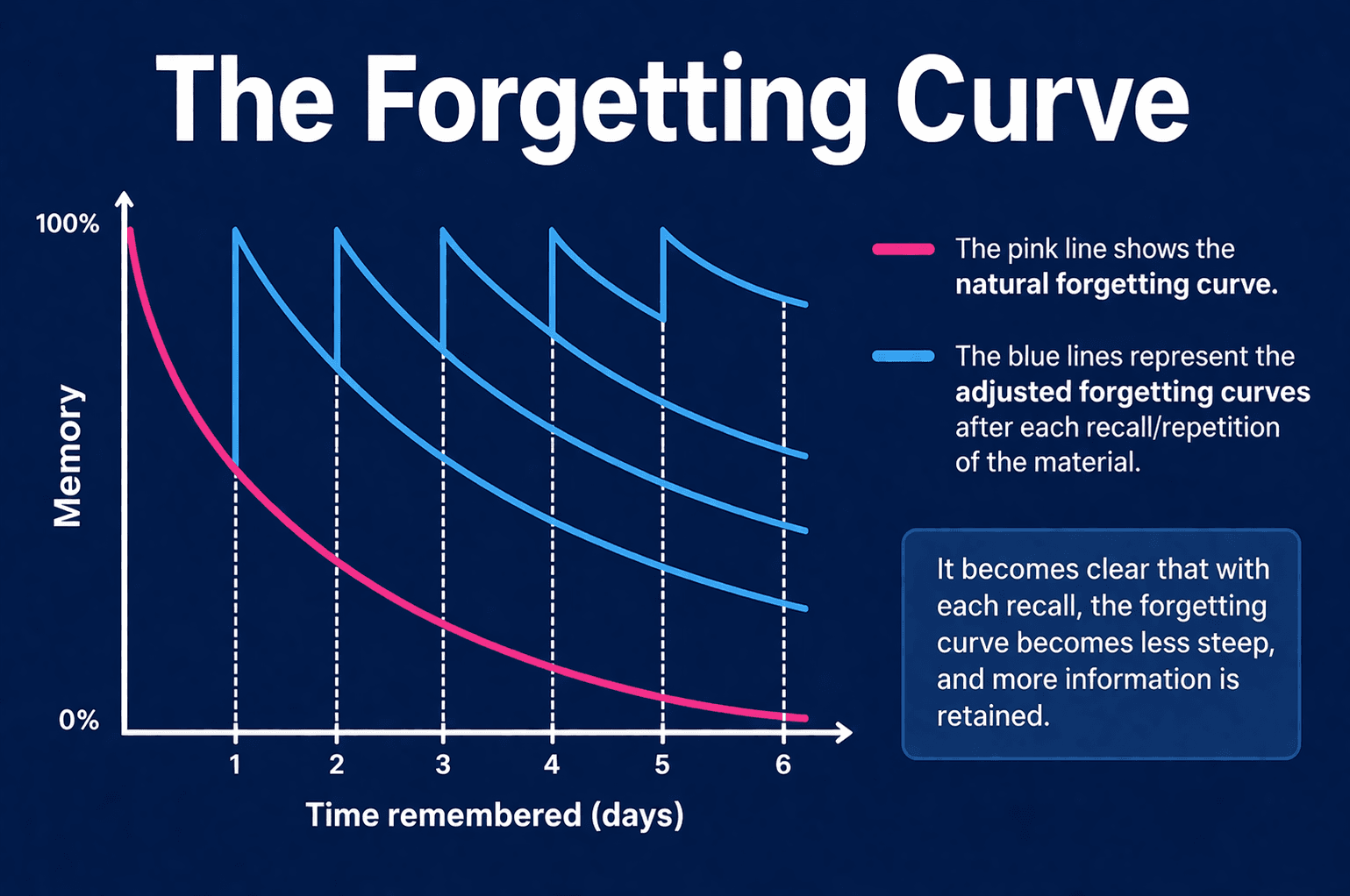
The forgetting curve represents the pace at which you forget information. In a traditional study where we study things only once, this curve has a steep downward trend, meaning you forget most things within hours.
But when you study things in the spaced repetition way, this curve flattens with each session. The flattening of the curve means you will keep that thing in memory for longer now.
There comes a point when this curve becomes so flat that you might not need to review that information again for months or even years.
There are many things that we learned at a young age and still remember to this day. Take multiplication tables, for example. We memorized them the spaced repetition way without knowing it.
When and when not to apply spaced repetition
You can learn a lot of different things using spaced repetition. But at the same time, there are things and times when you cannot apply the technique.
Let’s explore both situations.
When to apply spaced repetition
Most people use spaced repetition for learning a new language. The popular language learning app Duolingo also uses the technique to help people learn vocabulary quickly. But you can use it to learn grammar as well.
Another area where spaced repetition is applied a lot is science and medicine. Medical terms, chemical equations, anatomy facts, etc, are things that require pure memorization. And if you know, medical knowledge is fraught with complex terminology, which is difficult to read, let alone memorize.
So students of this field turn to spaced repetition to memorize things for the rest of their careers.
Then there are some less obvious things you can practice with spaced repetition:
- Historical dates and events
- Math formulas
- Chemical equations
- Musical scales
- Motor skills
- Name and face associations
- Memory recovery (for patients)
Simply put, you can apply spaced repetition to any material that requires you to recall a specific piece of information from memory.
Now let’s tell you about things that don’t get along with this technique.
When spaced repetition isn’t suitable
Carefully read the basic rule of applying spaced repetition in the previous section. It says the technique is good for memorizing “a specific piece of information.”
What this means is that you shouldn't try to apply this technique to complex paragraphs or huge chunks of text. That’s because spaced repetition is most commonly practiced with flashcards. And if you have worked with flashcards before, you know they work well for studying small and consumable ideas. You won’t remember trying to memorize a whole page of a textbook with them.
So that’s one type of material that you cannot study with spaced repetition.
Another situation where you cannot use spaced repetition is when you have an urgent deadline, like an exam scheduled for tomorrow.
If you need to prepare for an exam using the spaced repetition technique, you need to start the sessions well in advance of the exam date.
If you don’t start early and the exam day is upon you, you are stuck with cramming, even though it isn't as effective for long-term memory.
RemNote is the best spaced repetition tool for learning
Spaced repetition is best implemented with flashcards. But manually making paper flashcards for every subject and then organizing them between sessions takes too much time and effort. That much time and effort should be spent on learning, not on preparing the learning materials.
What else can you do then? You should use spaced repetition apps and flashcard makers like RemNote that streamline the flashcard-making process and also schedule reviews for you.
You can install it on your device and take notes inside it during the class. To turn those notes into flashcards, you just need to include some symbols to make different types of flashcards.
RemNote lets you make all the different types of flashcards that exist, such as:
- Basic flashcards
- Bidirectional flashcards
- Descriptor cards
- Cloze cards
- Multiple choice cards
- Image occlusion cards
Taking notes isn’t the only way to create cards. You can upload documents, and RemNote will create cards from them. There’s also a way to make card decks with AI by giving it just a topic.
Once your cards are ready, the system schedules reviews of them based on the spaced repetition algorithm.
We have just scratched the surface. RemNote’s flashcard and spaced repetition system has a lot more features that you can only properly explore by using the tool.
Sign up for RemNote for free today and put spaced repetition into practice.