
How to Memorize Faster: 12 Science-Backed Techniques That Work
Did you know that within 24 hours, the average person forgets close to 70% of what they learned? This discouraging drop-off is called the Ebbinghaus forgetting curve. It was first documented by the German psychologist Hermann Ebbinghaus in 1885, and it is the main reason the information you absorbed during last night’s cramming session slipped away by breakfast.
Don’t worry, the good news is that the last century of memory research has discovered several techniques that help you escape this inevitable memory loss. As the UNC Learning Center puts it, "memorizing is not just for an elite group of people born with the right skills. Most people are able to train and strengthen their memory muscles with a little patience and consistency.
In this guide, we will cover:
- the exact 3-stage process your brain goes through to form memories
- 12 science-backed techniques for making new information stick
- The practical routine you can begin today
TL;DR
- Your memory formation goes through a three-step process: encoding, storage, and retrieval.
- The most effective techniques for retaining what you learn are spaced repetition, active recall, dual coding, and elaboration.
- Passively reading over your material is the least effective way to memorize
- Good sleep and exercise are underrated memory enhancers
The 3-Stage Memory Framework
Cognitive psychologists divide memory formation into a three-step process.
Encoding
Encoding refers to how your brain absorbs new information. The more meaningful, connected,d and related your material is, the more effective the encoding. Scientists have also found that visual and verbal inputs can help reinforce encoding.
Storage
Storage refers to how your brain stores and retains information over time. Without regular repetition, most of the information that passes through your brain moves from short-term storage to long-term storage and eventually disappears.
Retrieval
Retrieval refers to your brain’s ability to access stored information. Retrieval is very much like a muscle. The more you practice, the easier it becomes for you to access information when you need it.
Every technique in this guide strengthens your brain’s natural way of memorizing information.

12 Science-Backed Techniques to Memorize Faster
1. Spaced Repetition
Spaced repetition is the act of reviewing materials at increasing intervals. For example, you can go over a concept the next day, three days later, a week later, two weeks later. Spaced repetition works by scheduling each review right before you forget. Digital tools and apps that use spaced repetition algorithms take the guesswork out of when to review.
Example: Learn 20 new vocabulary words on Monday. Review Tuesday, Friday, next Wednesday, and again ten days later.
2. Active Recall
Testing yourself is much more effective than passively reading over your materials. Every time you ask your brain to pull out information, you are strengthening the neural pathways responsible for that recall. This is why flashcards can be such an effective way to improve recall. Creating flashcards as you learn is a great way to improve memory and make sure you have study materials for later.

Example: After reading a section, close the book and try to remember the main points. Check back to see how well you were able to recall it.
3. Dual Coding
Your brain has two separate memory systems, one for visual and one for verbal memory. When you encode information using both, you strengthen recall significantly.
Your brain has separate visual and verbal memory systems, and encoding information in both dramatically strengthens recall. Diagrams, sketches, and annotated slides are great for reinforcing information.
Example: Instead of just reading a definition, draw a labeled diagram of the concept. PPT annotation tools let you add comments and notes directly onto lecture slides, helping you engage with the material more actively.
4. Chunking
Chunking is breaking complex information into smaller, more manageable groups. Cognitive psychologist George Miller famously showed that working memory can only hold about seven items at a time. Chunking allows you to absorb more information.
Example: Phone numbers are chunked into three groups (555-234-7891) because three chunks are much easier to hold than ten digits. For dense reading, PDF annotation lets you break a chapter into meaningful sections visually.
5. The Memory Palace
The Memory Palace is an ancient technique that involves visualizing and mentally placing information along a road or route or inside a familiar space or building. People have used this technique to memorize decks of cards and thousands of digits. It was even used by Roman orators in ancient times to memorize speeches.s
Example: To memorize a list of biology terms, mentally walk through your house and place each term in a specific room.
6. Mnemonics
Mnemonics refer to acronyms, rhymes, and songs that link information together and make it easier to remember. You might remember "PEMDAS" (Please Excuse My Dear Aunt Sally) for the math order of operations.
Example: For the taxonomy ranks (Kingdom, Phylum, Class, Order, Family, Genus, Species), the classic mnemonic is "King Philip Came Over For Good Soup."
7. Interleaving
Interleaving is a fancy way of saying alternating between different topics. Rather than studying long sections on a similar topic, shorter sessions on a variety of topics can be more effective for long-term retention.
Example: Instead of two straight hours of biology followed by two of history, alternate every 30 minutes.
8. Elaborative Encoding
Connecting new information to what you already know can form relevant paths in your brain that make it easier to recall complex information. UNC's Learning Center has a good example: to remember that water boils at 212°F, if 212 happens to be the first three digits of your friend's phone number, imagine throwing your phone into a boiling ocean.
Example: When you create study flashcards, include the definition on the back plus one connection to something you already know.
9. The Feynman Technique
Named after physicist Richard Feynman, this technique gets you into the teacher role. The idea is to pretend you are trying to teach your topic or the thing you're trying to memorize to a curious child.
Example: Try to explain how memory encoding works to a friend using only everyday words. Notice exactly where you get stuck.
10. Sleep and Consolidation
Your brain does most of its memorization during sleep, not during active study and review. Especially in deep sleep and REM sleep, studies consistently show that reviewing materials shortly before bed helps and encodes them more deeply. Pulling an all-nighter, on the other hand,d does the opposite.
Example: Review your hardest material 30 minutes before bed, then actually sleep at least seven hours.
11. Physical Exercise
Believe it or not,t going to the gym can make you better at memorizing. Aerobic exercise increases the release of BDNF (brain-derived neurotrophic factor), a protein that supports the growth of neurons in memory-related regions of the brain. As UNC's Learning Center notes, "cardio and resistance training both have powerful effects."
Example: A 30-minute walk or run before a study session can measurably improve how well you retain the material that follows.
12. Digital Study Tools
There are a lot of great apps and tools on the market that help you tap into some of these science-backed techniques automatically. An AI flashcard generator turns your notes into review decks in seconds, PDF to flashcards does the same for whole chapters, and an AI note taker captures lectures you can review later.
Example: Instead of writing 200 flashcards by hand, generate them from your source material and spend that time reviewing.
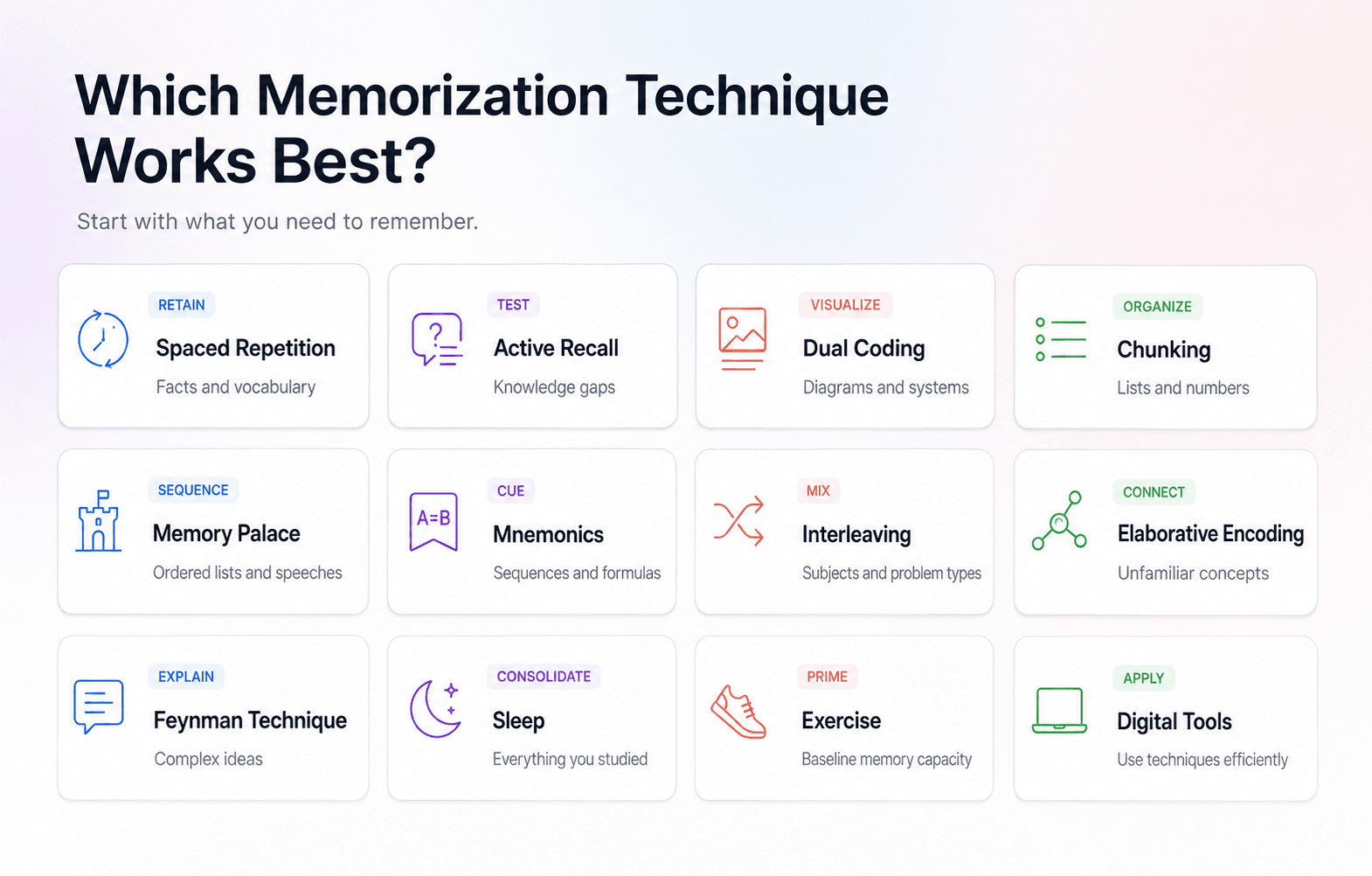
Which Memorization Technique Works Best?
The best technique depends on what you're trying to remember and why. To help you decide:
For a deeper look at the tools that support these techniques, our roundups of the best flashcard makers and best Quizlet alternatives compare the major options.
Common Memorization Myths
- Passively reading your notes helps you memorize them
- Cramming lots of information into your brain in a short period of time helps you memorize
- Some people have better memories than others
A Practical Study Routine
Morning: Spend 20 minutes using spaced repetition to review yesterday's flashcards along with anything else that your app has scheduled for you.
Study session (60 minutes): Block off a 60 Minute study session dedicated to learning new material and practicing active recall by testing yourself or interacting with the material. It is a good idea to take a break every 25 minutes and protect your focus.
Afternoon or evening (15 minutes): Spend 15 minutes in the evening quickly reviewing the material from today's sessions. You can use this time to practice retrieval and see how well you managed to absorb the information.
Before bed (10 minutes): To end off the day, spend 10 minutes going over the material you found most challenging. Don't forget that a good night's sleep is one of the best study strategies out there.
Study tip: Med, law, and other high-volume memorization students will find more in our best AI tools for medical students guide, and the broader best AI study tools roundup covers options that automate this routine. Pre-built study decks can also save you the trouble of building your own from scratch.
FAQs
How can I improve my memory?
Memory is a muscle and can be improved over time with the right kind of practice. The most effective techniques for improving memory capacity are active recall, dual coding, and, of course, getting enough sleep and exercise. Practicing any of these techniques throughout the week will improve your memory significantly over time.
How do I retain information for longer?
The only way to move Knowledge from short-term memory to long-term memory is through repetition, and specifically at spaced intervals. Reviewing something once is not enough. But if you review it three or four times over a week, the difference is significant.
How long does it take to memorize something?
The length of time it takes to memorize new material is largely dependent on the type of material, your existing knowledge of the topic, as well as your previous experience memorizing information. Effective memorization is more a function of technique than of time.
Is there a fastest way to memorize?
Combining active recall with spaced repetition is the fastest evidence-backed approach for most material. Add dual coding for anything visual, and elaborative encoding for anything abstract.
Do memory apps really work?
Yes, when they use spaced repetition and active recall at their core. The apps just automate techniques that would work on paper too, and they remove the friction that stops most students from being consistent.

