
AI Flashcards vs Traditional Flashcards: Which Works Better?
You have just been briefed on your upcoming midterm, and you have 400 vocabulary terms to memorize in the next 4 weeks. You know flashcards are the way to go here, but you aren’t sure what the best approach is. Your options are writing your vocab terms on traditional flashcards or having AI generate them for you.
A few years ago, this wasn’t an option. Flashcards always meant paper. These days, AI is giving students more options for how they learn. The AI in education market is projected to grow from 5.8 billion to over 32 billion by 2030. One of the strongest use cases is flashcards. Students are generating thousands of cards from PDFs, lecture slides, and YouTube videos.
Is faster always better? Not necessarily when it comes to memory and knowledge acquisition. In this article, we will compare traditional vs. AI-generated flashcards to see which one comes out on top.
TL;DR
- AI can generate flashcard decks automatically from notes, PDFs, slides, or videos. They are best for high volume, speed, and quickly reviewing material you are already familiar with.
- Handwritten flashcards, or manually typed digital cards, require that you write each card yourself and are best used for a deep understanding of topics you are still wrapping your head around.
- The act of making flashcards is a form of learning, so AI shouldn’t replace your process fully.
- The best workflow for most students is hybrid: handwrite cards of the difficult material and use AI to handle the rest.
Tools like RemNote combine both processes- manual flashcard creation in your notes plus AI generation from any document.
What Are AI Flashcards?
AI flashcards create learning decks generated by artificial intelligence from source materials that you provide. You can upload PDFs, lecture notes, or links to videos, and the tool is able to extract key concepts and turn them into q & a cards for you.
How They Work
The AI scans your source and pulls out facts, definitions, and key terms. It then formats each one as a flashcard. Most tools you use will also allow you to choose which card types you want (Q&A, cloze deletion, multiple choice), edit the output, and reorganize decks. The best tools also schedule your reviews automatically using spaced repetition.
The AI scans your source for facts, definitions, and key terms, then formats each one as a flashcard. Most tools let you choose card types (basic Q&A, cloze deletion, multiple choice), edit the output, and reorganize decks. The better tools also schedule reviews automatically using spaced repetition.
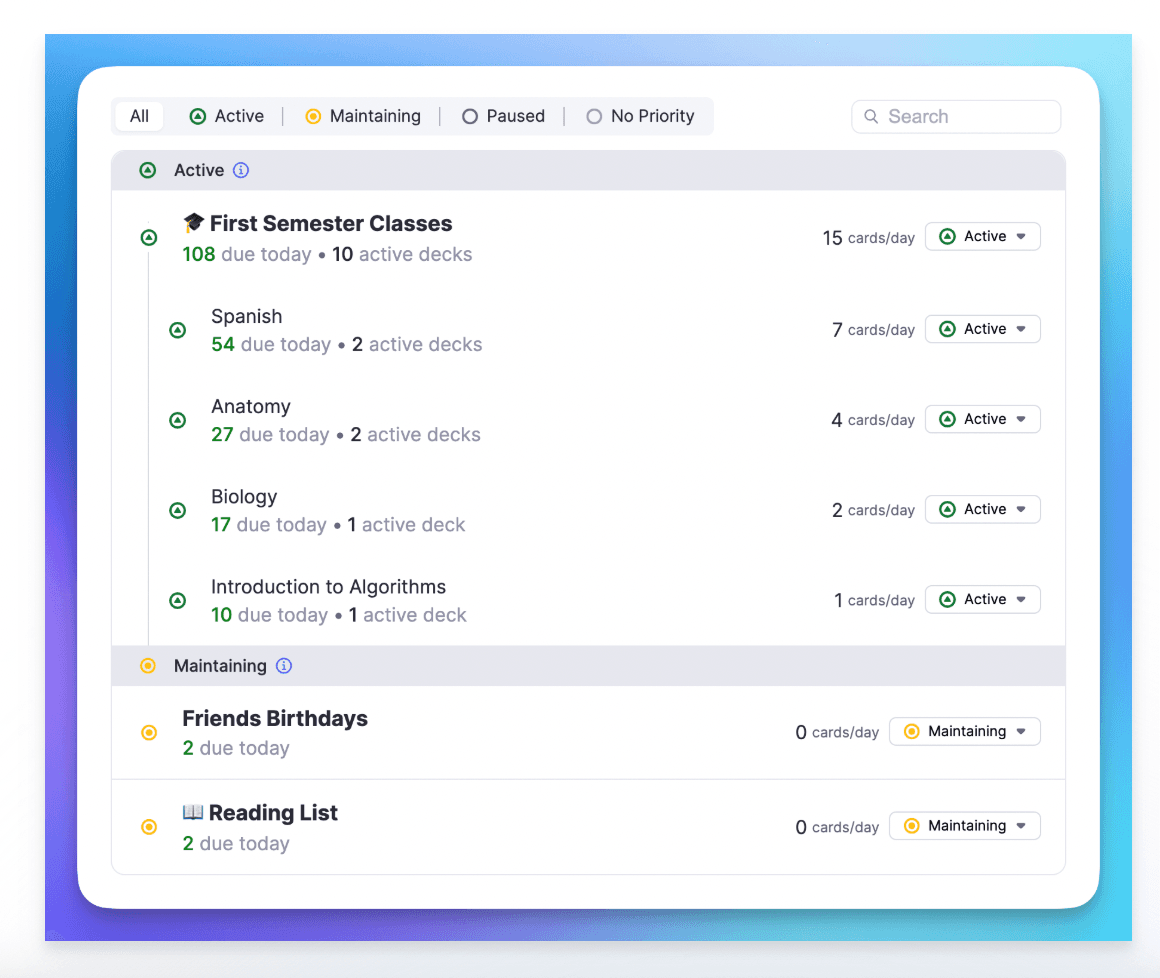
RemNote figures out when you need to practice each flashcard for you, at the exact time when you'd otherwise just be about to forget the idea.
Popular AI flashcard tools include RemNote, an AI flashcard generator that creates cards from PDFs, slides, and videos while letting you build them manually inside your notes. Other tools that have similar functionality are Quizlet, which added AI to its existing platform, Anki with community AI plugins, and newer apps like Knowt and Brainscape.
What Are Traditional Flashcards?
Traditional flashcards are physical or sometimes digital decks that you create yourself, manually, one card at a time. They usually come in three forms:
Physical cards are handwritten index cards on pre-printed cardstock. This classic format is distraction-free, but the most time-consuming to make.
Handwritten digital cards are written by hand on a tablet using an app like Notability or GoodNotes. These combine the cognitive benefits of handwriting with digital convenience.
Manually typed digital cards are typed one at a time in apps like Anki, Quizlet, or RemNote without using AI. You're still thinking, just typing instead of writing.
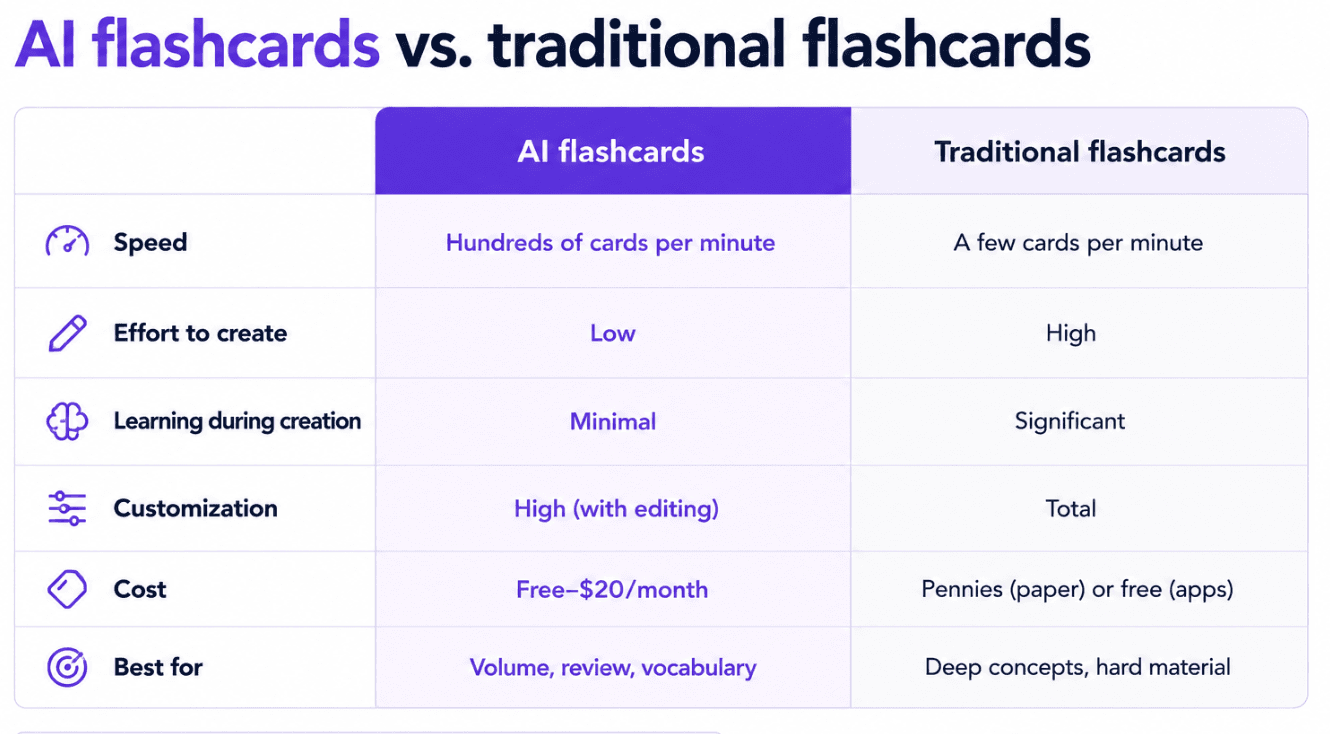
AI Flashcards Vs Traditional Flashcards: Key Differences
Content creation
AI tools can generate cards from any source. Whether it’s a 200-page textbook, a 60-minute lecture or a stack of slides- you upload, and the tool does the rest.
Traditional flashcards require you to read the material, filter out the key information you need, and then decide what to write on the flashcard. It is a much slower process, but a great way to learn.
Time
Making flashcards the traditional way- pen and paper in hand- takes hours, sometimes days. This is where AI has a huge advantage. It can take under a minute to generate hundreds of flashcards. For students in memorization- heavy fields like medicine, law, or language learning, the volume of flashcards they need to produce can be intimidating.
Learning Effectiveness
Research into the generation effect shows that information you produce yourself, by hand, is remembered better than information you read. Writing a card by hand forces you to summarize, paraphrase, and make decisions about what to include and what to leave out.
For material you are still working through and don’t fully understand, writing by hand can be a useful learning retention strategy. For much of memorization-based material, however, like anatomy terms, AI flashcards can be just as effective while saving you hours.
Spaced Repetition
Spaced repetition works by scheduling reviews based on how well you remembered each card. The system will show you cards you are weak in more often and ones you confidently recall.
There are systems that allow you to apply the idea of spaced repetition with traditional flashcards. The Leitner box system, for example, has been around since the 1970s.
Cost
Paper flashcards come in packs of 500 and cost anywhere from$ 5 to $ 10s. They are cost-effective and accessible to most students. Most digital flashcard apps have free tiers you can take advantage of, with paid AI features ranging from $5 to $20 per month. Some tools, like Anki, come at no cost but lack much of the useful AI functionality.
Customization
Traditional flashcards come in different colours and are quite versatile. You can customize what goes on them completely. AI- generated cards don’t usually allow for customization unless you edit the output.
Portability and Sharing
Would you carry a brick-sized stack of flashcards if you could just have them available on your phone? The biggest advantage of digital flashcards comes from their portability and the ability to share them easily. Most apps will allow you to publish decks to community libraries, which means you can skip the line and use a deck someone else built for the same course or exam.
What Does Learning Science Say?
There are three elements of the cognitive psychology debate that relate to the use of digital flashcards:
Active recall is the act of pulling information out of memory. When we engage in this form of recall, it acts as a powerful learning technique. A landmark 2008 study by Karpicke and Roediger in Science found that students who self-tested with recall remembered about 50% more after one week than students who only re-read the same material. The benefits of self-testing are there regardless of the type of flashcard you use: digital or traditional.
Spaced repetition is when you review material at larger and larger intervals. Why do this? Psychologist Hermann Ebbinghaus called the forgetting curve. Students who review on a spaced schedule retain dramatically more than students who cram.
The generation effect states that by making something yourself, from scratch, even if imperfect, you encode it more deeply than by acquiring it. This is the strongest argument for making your flashcards by hand.
AI flashcards leverage two of the three principles (active recall and spaced repetition) automatically.
AI Flashcards Vs Traditional Flashcards: Which Should You Choose?
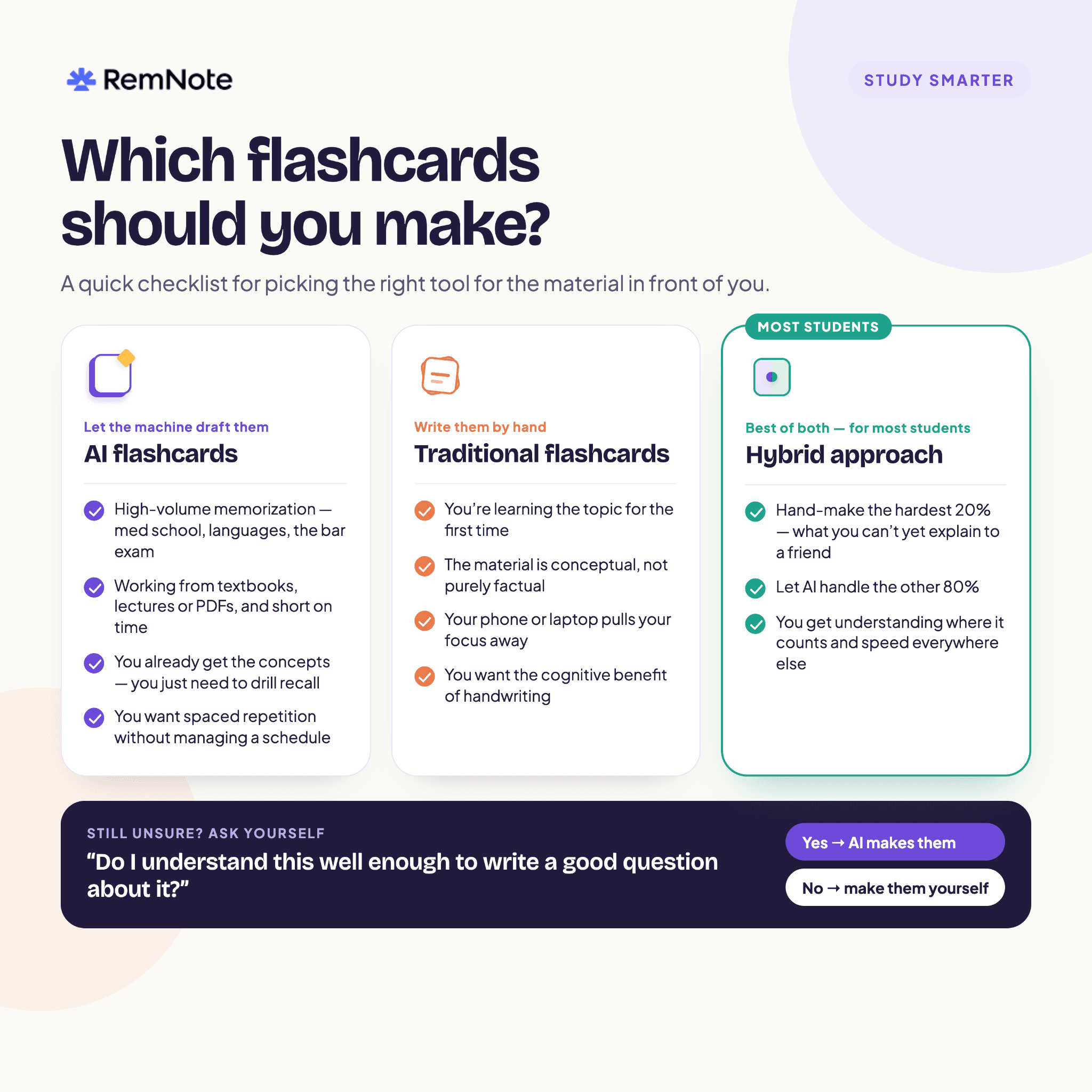
How Remnote Combines The Best Of Both Approaches
RemNote is built on the idea that there are instances where AI flashcards make way more sense. We know how students learn and the best ways to absorb information. The traditional vs. AI debate misses the point.
- Make flashcards while you take notes. What if you could capture a flashcard as you were listening to your professor? You get the benefit of the generation effect without much of the manual effort.
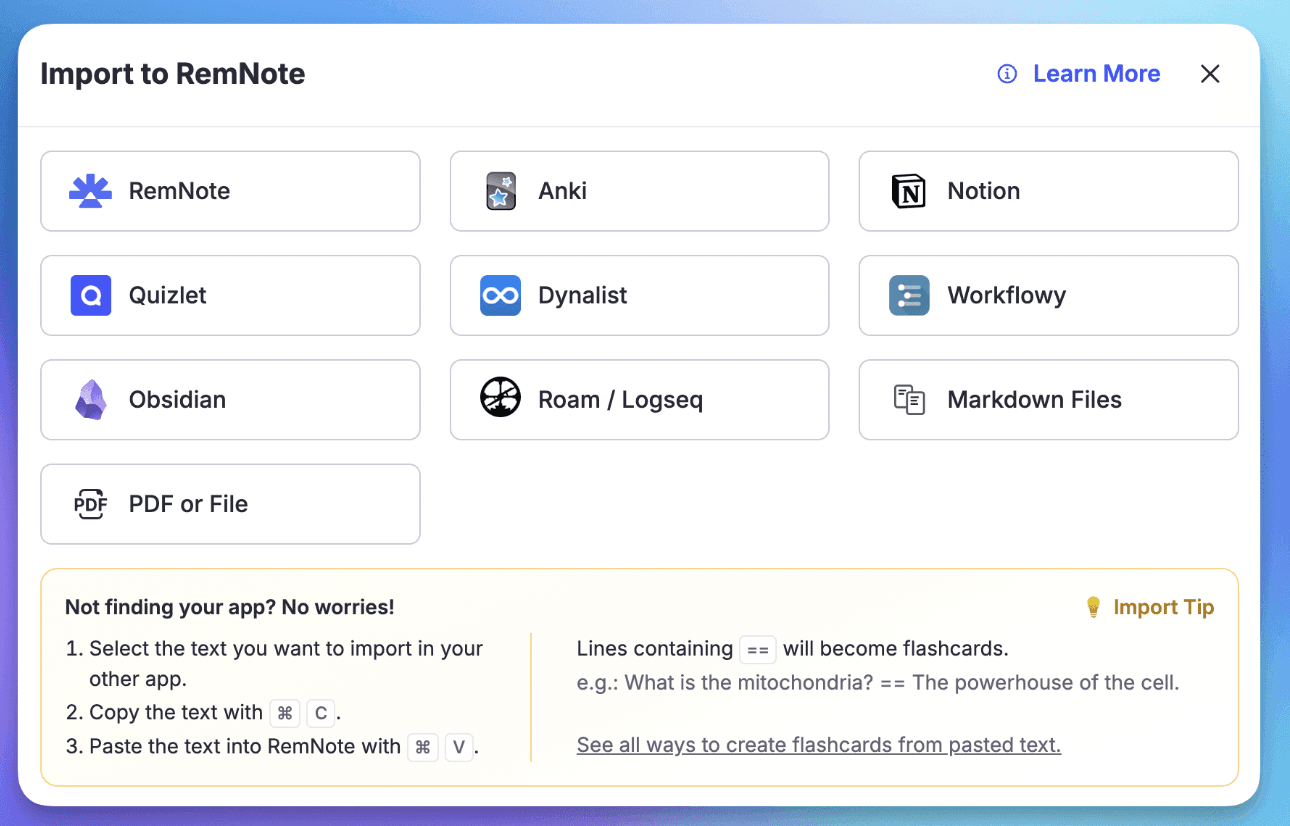
- Generate cards with AI when you don't have time. PDF to flashcards produces a complete deck from any PDF document you upload. Same for slides, lecture videos, and pasted text.
- Edit AI-generated cards. Every AI card is editable so you can rephrase questions, add personal wording, or split cards up.
- Built-in spaced repetition. Cards you create as study flashcards, whether manually or with AI, are scheduled using a research-backed algorithm.
- All card types. Basic, cloze, multiple-choice, image occlusion, and more — create flashcards in whatever format fits the material.
If you've been bouncing between Quizlet alternatives or hunting for the best flashcard maker that supports both workflows, RemNote is worth a try.
FAQs
Are AI flashcards better than traditional flashcards?
We don’t believe in the debate between traditional and AI flashcards. In many instances, rote memorization is the name of the game. High- volume medical terms, legal terms, technical terms. A hybrid approach of using traditional and AI- assisted flashcards is the way to go.
Can AI replace creating flashcards yourself?
AI can get you 99% of the way there. Plus, there is a huge cognitive benefit to writing or assembling your own cards. It’s called the generation effect, and it’s a real thing that proves you learn better when you make something by hand. Use AI for drills, reviews, and memorization. When you require deep understanding, there is nothing as effective as doing something the old- fashioned way- pen and paper.
Is RemNote better than Anki and Quizlet?
Anki is the most complex of the three and has the steepest learning curve, but it has a huge community of already- built decks. Quizlet is simple and so has limitations. RemNote has note-taking, flashcards, and AI generation in one place, which suits students who want their notes and cards to live in the same system. Try the free tier to see what it can do.

