
How to Make a Study Schedule That Actually Works

Building the perfect study schedule is easier than ever. A quick prompt in your favorite LLM and you have a perfect, colour-coded, time-blocked plan. The only downside is that you will likely be unable to keep up with it. Most study schedules go off the rails not because of a lack of discipline, but because of a lack of customization. A good study schedule is one tailored to you- your life, your schedule, your strengths.
An effective study schedule integrates studying into your day-to-day in a way that makes knowledge transfer almost inevitable. As the Cornell Learning Strategies Center puts it: "It's easier to keep up than to catch up." This guide walks you through why most schedules fail, the step-by-step process for building one that sticks, the tools and techniques that make it easier, common mistakes to avoid, and answers to the questions students ask most often.
TL;DR
- Map out your term deadlines or goals
- Audit how you use your time
- Block your fixed commitments (classes, work)
- Schedule in study sessions around your commitments
- Build in weekly breaks and review periods
- Adjust the schedule regularly
Why Do Most Study Schedules Fail?
Most study schedules fail for the same handful of reasons most extreme diets fail. Recognizing them before you make a study plan will help keep you from falling off the plan by mid-week.
They're too ambitious.
A schedule that blocks off all your free time and assumes you will study five hours per day and never miss a session is more of a fantasy than a plan. Small, consistent steps are more effective.
They ignore fixed commitments.
If you plan to study but don’t take into account the time it takes to fulfill your fixed commitments, you are also making a plan that you will be unable to deliver on. Know the actual, honest time you have to study.
They underestimate time.
Cornell has a handy rule when it comes to this common misstep: estimate how long a task will take, then double it. No plan goes smoothly, and we all have the tendency to overestimate what we can do in a given period of time.
They forget breaks, food, and sleep.
Going without breaks, food, or sleep is not a scholarly badge of honor. Not taking care of your basic needs will actually decrease the effectiveness of your study sessions.
They copy someone else's system.
Other people’s plans can be a great starting point, but don’t make the mistake of lifting them without making sure they fit your schedule and life.
How to Make a Study Schedule That Sticks
Step 1: Get Clear on Your Goals and Deadlines
Before you get into the nitty-gritty and start blocking out colour-coded study sessions for later today, take a moment and look at the big picture. What are you working on this term? What is coming down the pipe? Is there an important deadline? At this point in the planning process, add anything that matters to your life. That could be grad school applications, part-time work, or volunteering. Don’t forget that visit with your family or other appointments you can’t reschedule.
A clear picture of what’s coming up will give you a realistic view of what study blocks you actually have available in your life.
Step 2: Audit Your Current Time
Honestly tracking how you spend your time in a week can be eye- opening because it’s usually not what you expect. Make sure you include everything: classes, commute, work, sleep, meals, exercise, social time, and time online. By going through this exercise, most students discover a few hours of "hidden time" they had no idea they were losing to forgettable activities like doom-scrolling.
Step 3: Map Your Fixed Commitments First
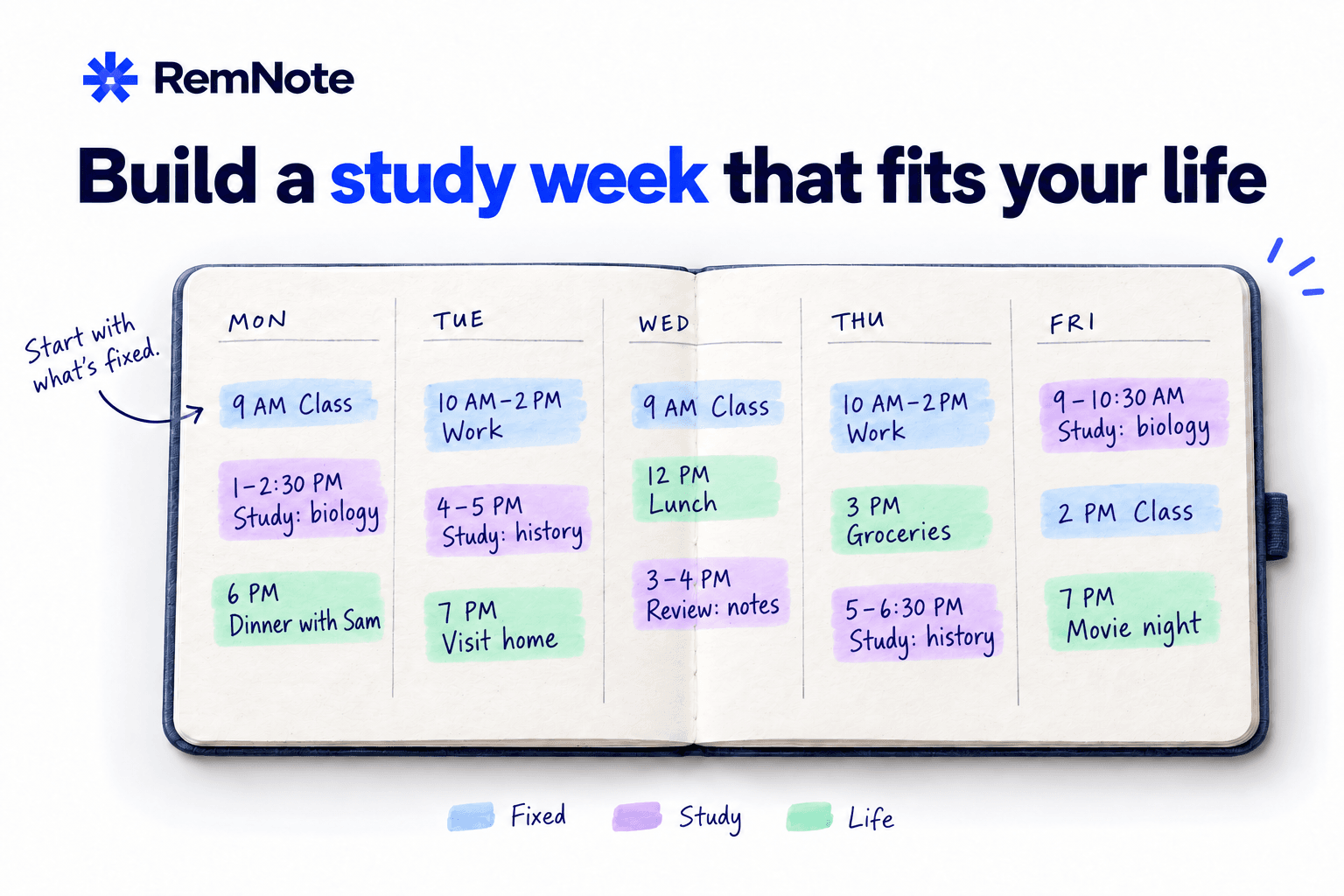
The first thing you need to put on your schedule is the work you cannot avoid. Classes, work shifts, meals, sleep, and any weekly commitments (sports practice, a standing meeting, religious observance) go in first. Your study time gets assigned around these commitments.
Step 4: Slot in Study Blocks and Vary the Subjects
Once you have your non- negotiable blocks in, look at the white space you have left. Identify 60- to 90-minute study blocks and vary the subjects you assign yourself to study. It's a good idea to avoid the same subject back-to-back for a whole afternoon. According to Cornell: "our ability to concentrate decreases rapidly after about 90 minutes". Switching subjects keeps you sharper and prevents you from falling behind in the courses you enjoy less.
Step 5: Build in Real Breaks, Sleep, and Life
Studying can seem urgent,t especially if you have an exam at the end of the effort. As nervous as you may be about your exam or big test, your study schedule should not just include studying. Build in short breaks between sessions, a full stop each evening, and at least one afternoon off each week. Weekly review time is important too, because of how a learning principle called spaced repetition works. By scheduling reviews right when you're about to forget material, you are more likely to retain that material in your long- term memory.
Study Tip: A tool that automates spaced repetition can save you the guesswork and design the perfect rotating schedule for you.
Step 6: Review and Adjust Weekly
It is completely normal to change or tailor your schedule after your first week. Take your planning day (usually a Sunday) and analyze the previous week. What worked? What didn’t? Are there any tweaks you need to make to stick to your schedule more consistently?
Tools and Techniques for Better Study Planning
A few tips and proven methods for studying success:
The Pomodoro Technique
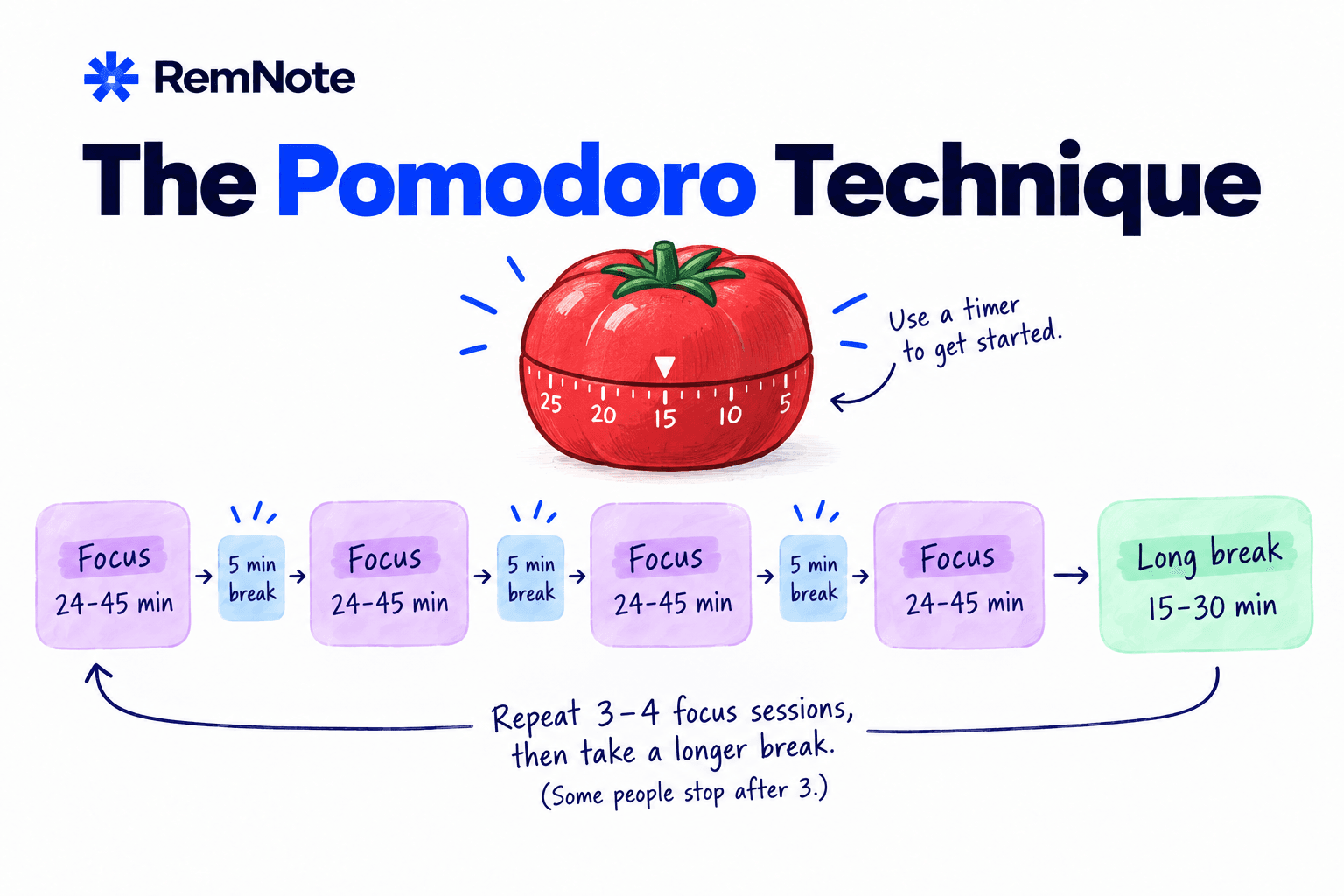
This technique is all about short, focused blocks (usually 24-45 minutes in length) and separated by 5-minute breaks. After you have completed 3-4 short Pomodoro sessions, take a longer 15-30 minute break. This technique is especially useful if you are having trouble getting started or focusing on a difficult task.
Time blocking
Time blocking is the act of assigning specific tasks to specific windows of time in your calendar. Rather than just making a list of what you need to do, committing to exactly when you are going to do it is the key to actually making it happen without pushing it off to tomorrow.
The two-day rule
Never skip the same subject two days in a row. This keeps you from falling behind in one course while you focus on another.
Digital study tools
Modern tools handle the repetitive parts of studying so your schedule can focus on the learning. An AI flashcard generator turns your notes into review decks in seconds, PDF to flashcards does the same for entire textbook chapters, and an AI quiz generator creates practice questions in your exam format. A full suite of AI study tools can replace hours of prep work with minutes.
Weekly planner or digital calendar
Using a planner is a major cheat code when it comes to studying. Physical or digital, it doesn't matter. What matters is having one place where you can look at the whole week ahead and spot conflicts and opportunities at a glance.
Common Mistakes to Avoid
- Copying someone else's perfect schedule without tailoring it to your own life
- Underestimating how much time it will take to study
- Overstudying by skipping breaks and self-care
- Studying your favorite subjects most of the time
- Building a strict schedule with no room for adjustment
- Scheduling in studying during times you are least alert
FAQs
How do you create a study schedule?
A study schedule starts with the big picture. Begin by listing your goals, any deadlines or important dates coming up. Layer in how you spend your time and your obligations outside of school (work, family, volunteering). Your study blocks should start to “appear” as chunks of white space in your schedule. Aim for 60 to 90 minute sessions and avoid studying the same subject back-to-back.
How do you study effectively for exams?
Start earlier than you think you need to. Break the material into small chunks you can approach daily without overwhelm. Alternate learning new content with reviewing what you've already covered, and use practice tests in the final week. The closer your practice format matches the exam, the better prepared you will be. Tools that let you create flashcards from your notes can help you speed up the process and use little chunks of time throughout your day.
How long should you study each day?
How long you spend studying each day depends on what you are preparing for. Large exams may require up to five hours of study per day in the weeks leading up to the assessment. For projects that are farther down the road, two to three hours per day could be sufficient. The key here is not so much volume, but consistency.
What time of day is best for studying?
When does your brain work best? Some people have the most alert brains first thing in the morning, while others turn on in the evening. The best time to study is the time that works for you. That’s why a custom study schedule is the way to go.
How do you stick to a study schedule?
Study schedules that actually stick share a few commonalities:
- They leave room for real life
- They include weekly review and adjustment time
- They don't rely on willpower alone
Digital tools can help reduce the friction (a free flashcard maker that generates decks from your notes instantly), making it much easier to hit your daily study targets.
What if I get behind?
Everyone feels behind in their studying at some point or another. The important thing is to plan for it and not panic by trying to catch up in one weekend. Cut what's not essential, focus on upcoming deadlines first, and get back to a sustainable pace as quickly as possible without giving yourself a hard time or judging yourself. If a specific tool is missing from your routine, our roundups of the best flashcard makers, Best Quizlet alternatives, and how to create study flashcards from notes can help you rebuild your workflow.