
Types of Memory: Semantic vs Episodic vs Procedural

Back in 1885, German psychologist Hermann Ebbinghaus published the first experimental study of forgetting. Using himself as the only subject, he memorized lists of nonsense syllables and measured how quickly he forgot them. He found that most forgetting happens soon after learning and then slows down, a pattern now known as the forgetting curve.
In 2015, researchers repeated his experiment. One participant spent 70 hours learning and relearning lists, then was tested after intervals ranging from 20 minutes to 31 days. The results closely matched Ebbinghaus's original curve. There was only one twist, though. Memory held up better than expected at the 24-hour mark. This bump is often linked to sleep.
However, memory loss is not random. Psychology research describes many types of memory that store different pieces of information, each of which fades for different reasons.
In this blog, we discuss these types of memory in psychology, how they differ, and what you can do to strengthen each.
TL;DR
Psychologists categorize types of memory by time duration into sensory, short-term, and long-term memory. Long-term memory is further divided into three subtypes, namely:
- Semantic (facts that you remember by spaced repetition and active recall)
- Episodic (your past experiences)
- Procedural (hands-on skills that get better with practice)
What Are the Different Types of Memory?
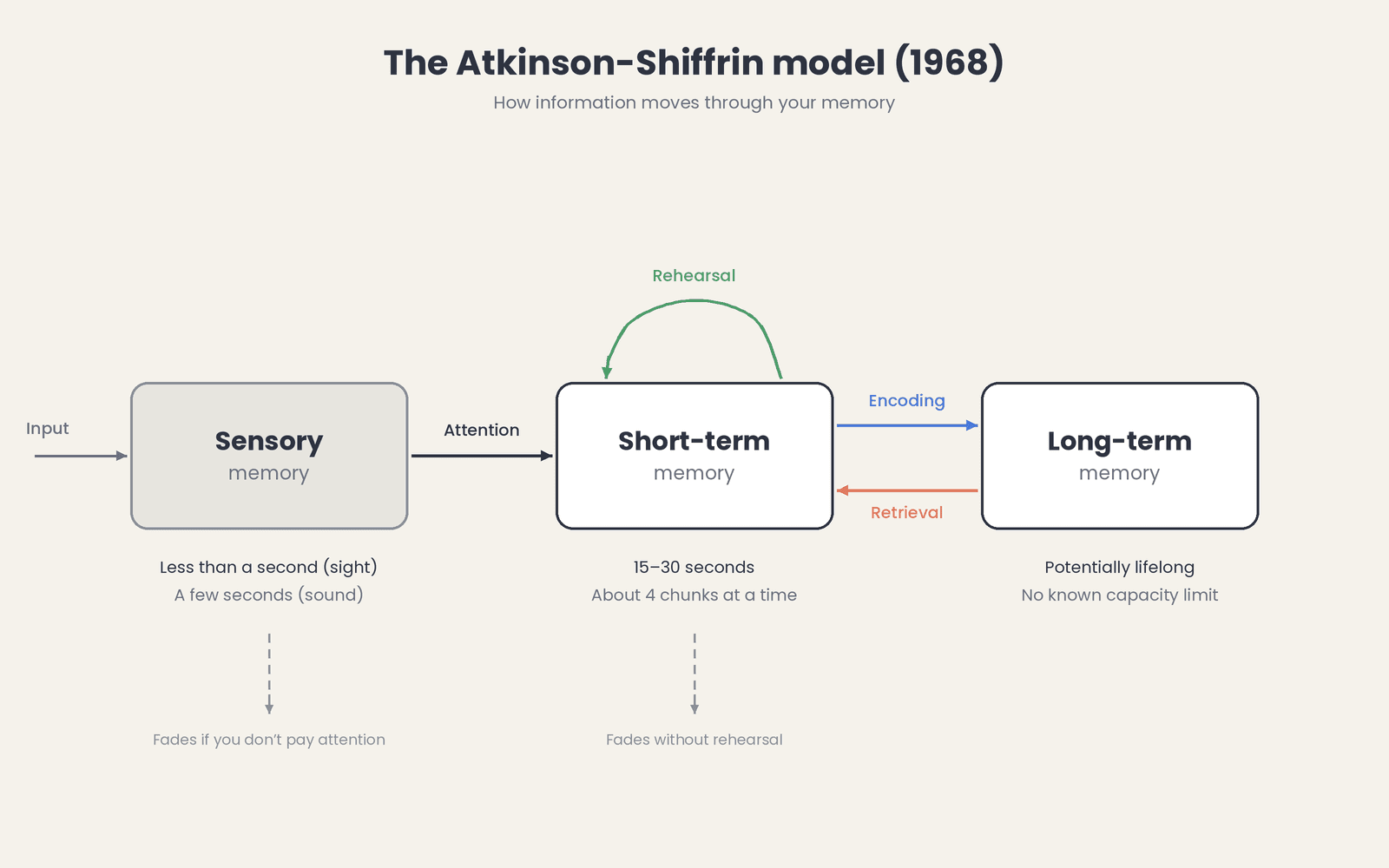
Psychology identifies 3 types of memory that explain how the human brain processes information. They are best explained by the Atkinson-Shiffrin model from 1968, i.e., any information that goes into the brain moves into the following types of memory in consecutive order:
- Sensory memory lasting for less than a second for visual input from your eyes and for just a few seconds for auditory input from your ears
- Short-term memory that lasts for 15–30 seconds. George Miller's 1956 study reported that you can hold 5 to 9 discrete chunks of information in short-term memory, but a newer estimate by Nelson Cowan in 2001 claims it is closer to 4 chunks. If you actively reason through the data stored in short-term memory, it is called your “working memory.”
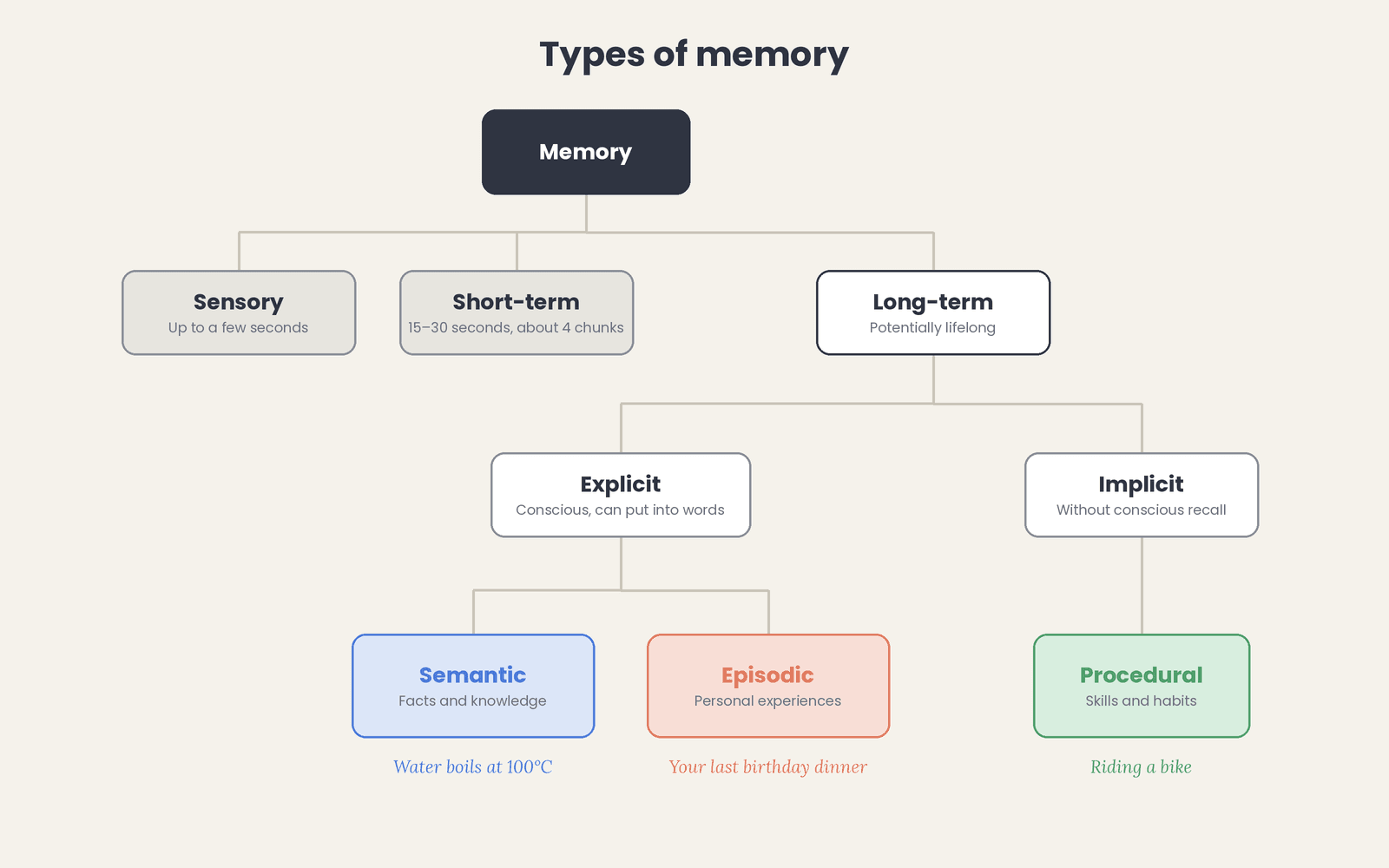
- Long-term memory is potentially lifelong and has no capacity limit. It can be further classified as explicit (either semantic or episodic) or implicit (procedural) memory.
Types of Long-Term Memory: Explicit vs Implicit
In 1972, Endel Tulving, a Canadian neuroscientist, proposed that any information that makes it into the long-term storage section of your brain is stored in one of two types:
- Episodic memory, i.e., time- and space-linked life events stored in your brain
- Semantic memory, i.e., factual knowledge you learn outside your real-life experiences, for example, that Paris is the capital of France.
Building on that work, the Professor of Psychiatry and Psychology at UCSD, Larry Squire, found that episodic and semantic are types of a broader category of long-term memory known as explicit memory. He described long-term memory as:
- Explicit memory, which is anything you can consciously recall and put into words, and it includes both episodic and semantic memory
- Implicit memory is what you know without conscious recall. It includes your skills and behaviors, such as riding a bicycle. Once you learn it, you just know how it works for the rest of your life. Procedural long-term memory is a form of implicit memory.
Explicit and implicit memories are stored in different parts of the brain.
What Are the Three Types of Memory? Semantic vs Episodic vs Procedural
Based on research by Endel Tulving and Larry Squire, psychologists generally agree that long-term memory can be divided into 3 distinct types.
- Semantic
- Episodic
- Procedural
Semantic Memory: What You Know
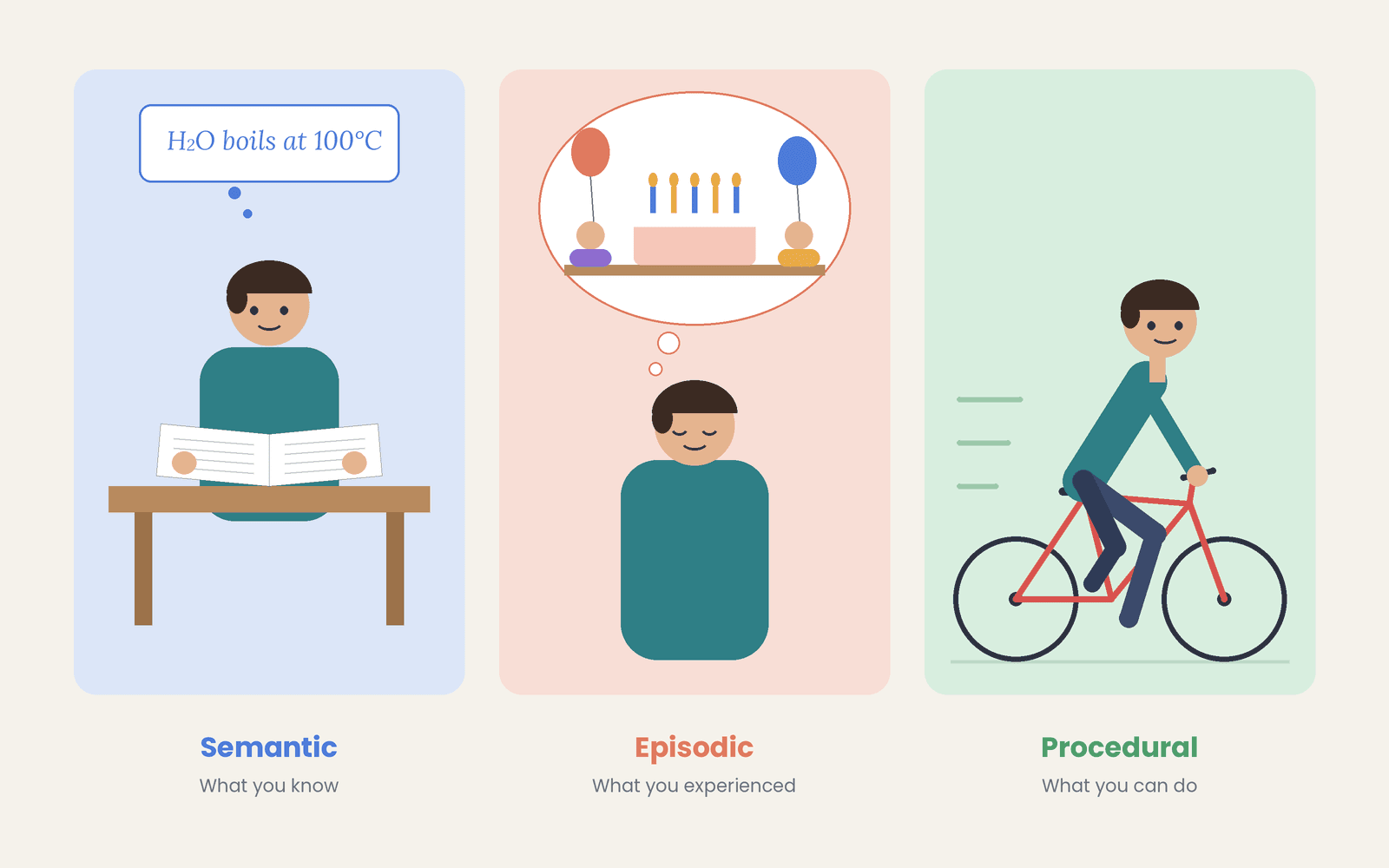
Anything that you learn about the world, either by observation (such as seeing that a dog has four legs) or through active learning (which includes science, language, vocabulary, math, etc) comes under semantic memory.
Knowing that water boils at 100°C or learning the exact steps of the Krebs cycle for an exam are examples of semantic memory.
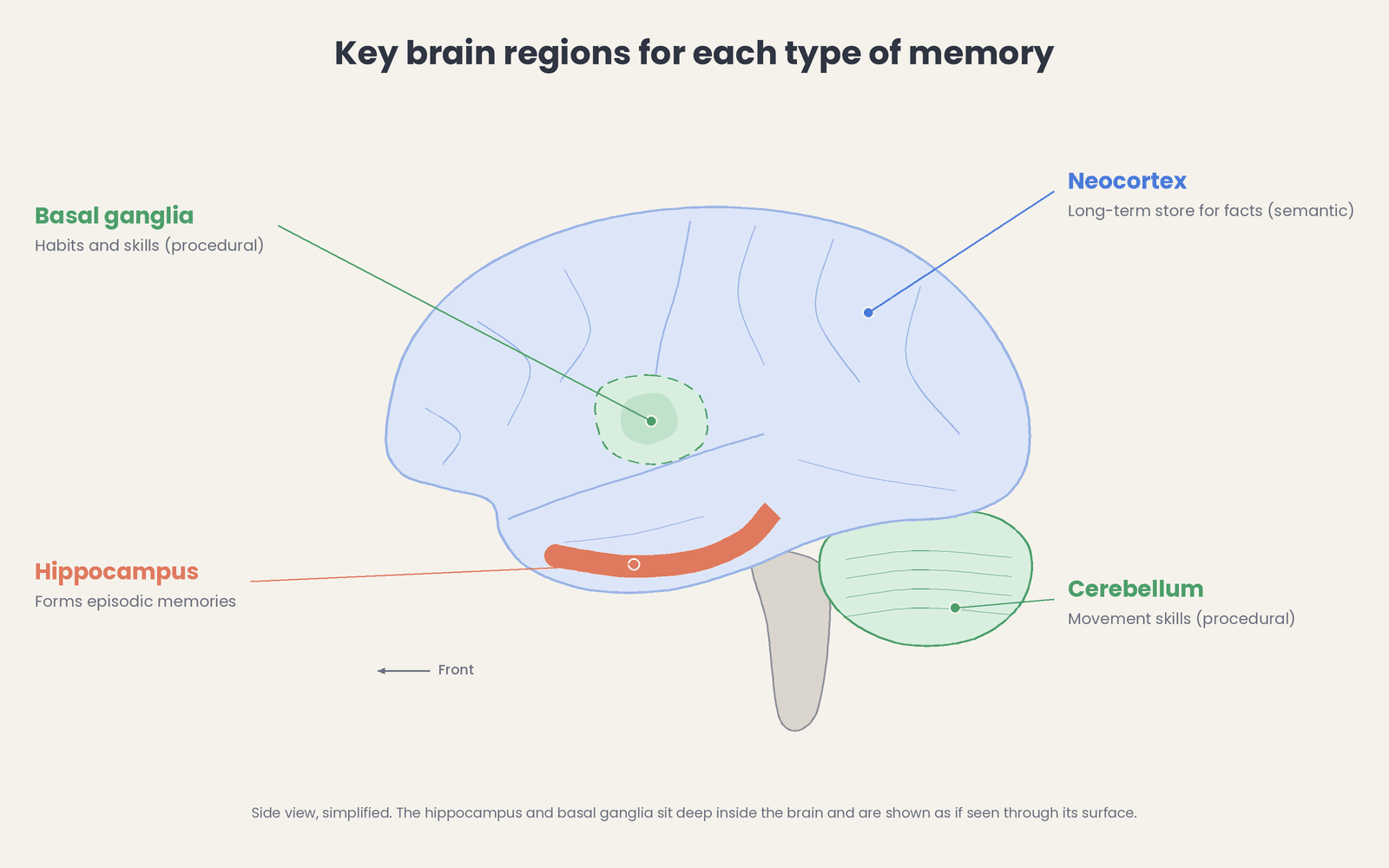
Any new information you learn goes into the hippocampus, a structure deep inside the brain that helps turn short-term memories into long-term memories and helps with spatial navigation.
Once encoded, it travels into the neocortex of your brain to be stored in semantic memory. You can strengthen it via spaced repetition and active recall.
Episodic Memory: What You Experienced
Episodic memory stores exact events from your past, tied to a time and place, that you can mentally travel back to. It includes, for example, the place where you had your last birthday dinner, or the spot in the lecture hall where you sat during an important lecture.
The hippocampus is critical for forming and retrieving episodic memories. Over time, and especially during sleep, these memories are gradually consolidated into the neocortex for long-term storage.
Emotion also strengthens episodic memory. You're more likely to remember a lecture that was surprising, funny, or stressful than an ordinary one, because emotionally charged experiences tend to be encoded more strongly.
An extreme version of this is flashbulb memory, which is an unusually vivid memory of where you were and what you were doing when you heard surprising, high-impact news. Flashbulb memories feel very certain, but research shows they are often less accurate than people believe.
Procedural Memory: What You Can Do
This type of memory describes the skills you can perform without thinking about the exact steps. Riding a bicycle, walking down a known way home from school, a lab technique you’re familiar with, and solving simple math equations are all examples of procedural memory.
Procedural memory actively engages the deeper structures of the brain, i.e., the basal ganglia and cerebellum. It is a product of repetition.
What’s interesting is that many times, it’s hard to explain things you know as procedural memory. You know how to do it, but it’s difficult to put it into words.
Semantic vs Episodic vs Procedural: Key Differences
| Type of memory | Semantic | Episodic | Procedural |
| What it stores | Facts, general knowledge | Personal events | Skills and habits |
| Is it conscious? | Yes | Yes | No |
| Example | Water boils at 100°C | Your last birthday dinner | The skill of riding a bicycle |
| Brain regions involved | Neocortex | Hippocampus (forming and retrieving), neocortex (long-term storage) | Basal ganglia, cerebellum |
| How it is built | Spaced repetition and active recall | One-time experience | Practice |
| How it fades | Not retrieving it periodically | Interference (similar memories compete with each other) | Disuse (durable, fades very rarely) |
How the Three Memory Types Work Together
The different brain structures work in conjunction, so these 3 types of memory interact with each other in almost every situation.
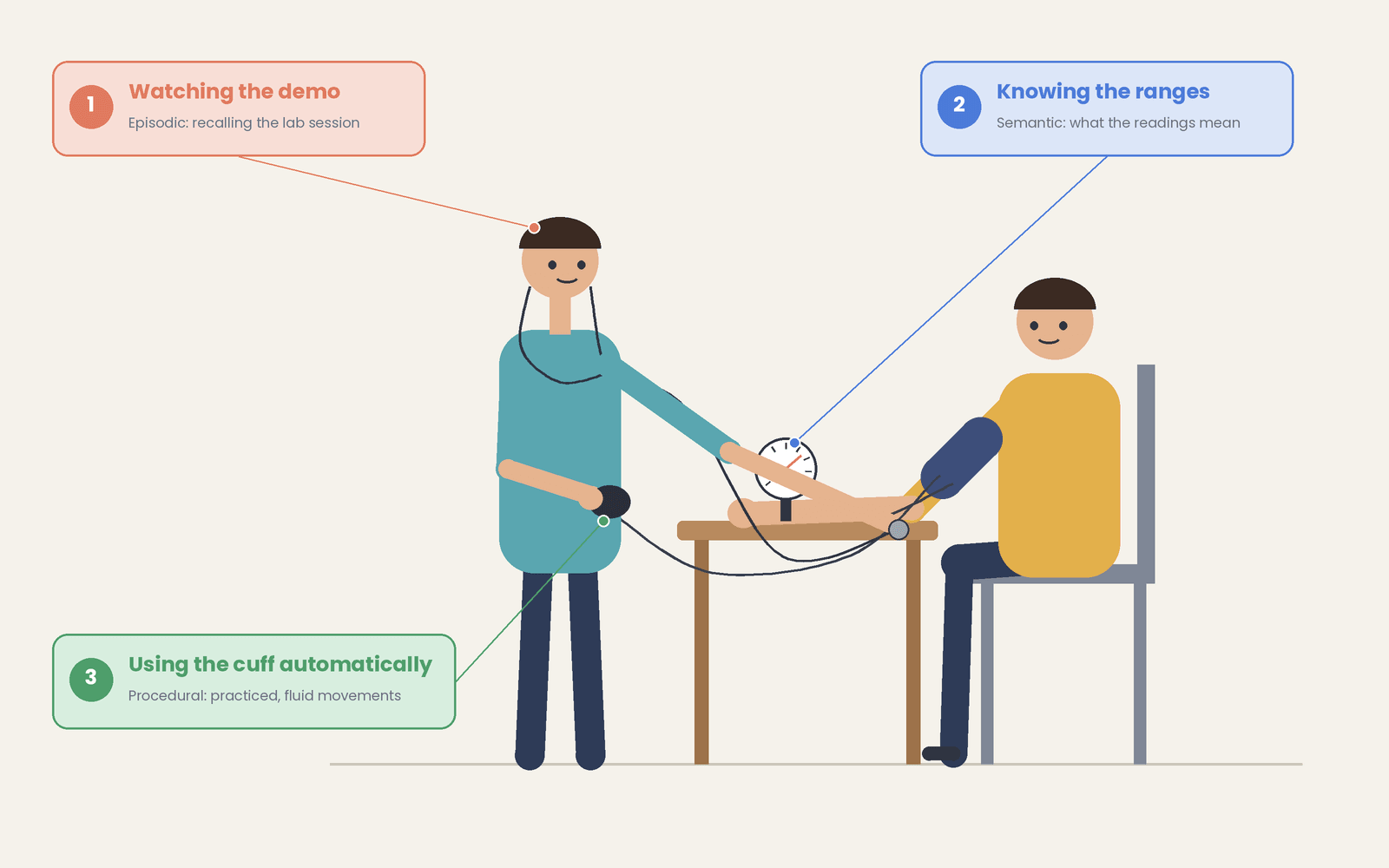
Let’s consider the example of a student learning to take blood pressure in a nursing class.
The student remembering the lab session where the instructor demonstrated the procedure to them is episodic memory. The student then learns to interpret blood pressure readings (the normal range, systolic and diastolic readings, etc.), which also becomes part of his semantic memory. Then, as he takes readings for multiple patients until using the cuff becomes an automatic reflex, it is also stored in procedural memory regions.
So, to learn something well, you need a memorable learning experience, retrieve the factual knowledge from it, and practice it until it's stored in long-term memory.
How to Strengthen Each Type of Memory When You Study
There has been extensive research into how you can strengthen different types of memory.
The following strategies are among the most recommended ones.
Spaced Repetition
Spaced repetition means reviewing what you learn at increasing intervals, just before you are likely to forget it.
The brain has a natural forgetting curve, i.e., your memory of factual knowledge (semantic memory) drops if you don’t review it. To prevent that, you review a concept right after you have learned it, then the next day, then 3 days later, then a week later, and so on.
Spaced repetition works best with flashcards. You can create physical flashcards or use a flashcard app to make digital decks from your notes.
An app is usually the easier option than the manual method because good flashcard apps like RemNote often come with built-in spaced repetition. Practicing spaced repetition with physical flashcards is cumbersome because it involves a lot of handling, sorting, and carrying.
Active Recall (Retrieval Practice)
Active recall refers to forcing your brain to recall knowledge from semantic memory rather than re-reading it.
Active recall happens through flashcards and practice questions. RemNote, Anki, Quizlet, etc are some popular online tools students use for active recall.
Multiple studies say it is among the most useful study techniques. A 2013 study compared 10 study strategies to understand what helps the students the most and reported practice testing to be the most effective way to improve learning.
Researchers at the University of California have shown that even failed recall attempts, when you see the correct answers afterward, improve memory more than passively reading the question and answer together.
Elaboration and Linking Ideas
The brain remembers information better when it connects it to a web of things you already know.
Elaboration requires you to go deep on a topic and think about the why, how, when, where, etc. related to the concept you’re studying. It builds rich context needed to strengthen your semantic memory.
Once you have elaborated it, you link all the related ideas using diagrams, flowcharts, sometimes by simply explaining them out loud to yourself. Doing so adds a personal experience to your learning material. Naturally, the brain areas responsible for episodic memory are also engaged.
Deliberate Practice for Skills
Your procedural memory only gets strong with hands-on practice. You need to keep repeating a skill and getting feedback to understand how to improve it until it becomes second nature.
It also helps to interleave your practice, which means mixing different types of problems in one session instead of practicing one type at a time. For example, if you want to practice integration, mix integration by parts, u-substitution, and partial fractions rather than doing 10 integration-by-parts problems in a row.
Interleaving forces you to figure out which method each problem needs, which is exactly what you'll have to do on an exam.
Sleep and Memory Consolidation
Many studies suggest that your sleep has a huge role to play in strengthening all 3 types of memory. When the brain rests, it replays recent events and moves them from temporary storage in the hippocampus to the neocortex for long-term storage.
A concept in science called retroactive interference suggests that new information you learn pushes out your older memories.
But research shows that getting good-quality sleep after learning something can protect memory from retroactive interference.
In 2023, researchers conducted an experiment with 120 healthy participants and found that participants who slept for 12 hours retained 78.17% of the original 20-word pairs list after learning an interfering second list, compared to only 53.50% for participants who stayed awake for 12 hours.
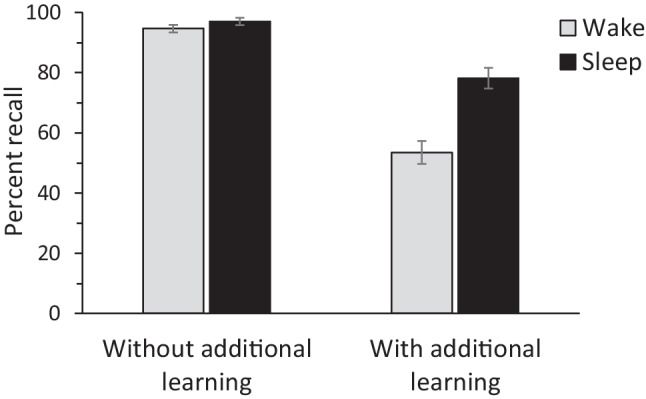
So if you are studying two similar or easily confused subjects (e.g., two foreign languages or related anatomical terms), schedule a night of sleep or a substantial rest between sessions rather than studying them back-to-back on the same day.
Stop Forgetting What You Study: Build Lasting Memory With RemNote
If you want to avoid forgetting information you want to retain long-term, we recommend checking out RemNote.
RemNote is a learning app that converts your notes into evidence-based study resources, such as flashcards and quizzes. It works best to support semantic memory.
The algorithm automatically spaces out flashcards to fight the forgetting curve using the classic SM-2 and Free Spaced Repetition Scheduler for maximum retention. Inline flashcards also help with active recall.
You can also link across different sections of your notes and create diagram-based flashcards in RemNote.
Sign up for RemNote to try it out for free today!
FAQs
What Are the 8 Types of Memory?
According to psychological research, there are no 8 types of memory. However, people tend to group different human interactions into sensory memory, short-term memory, working memory, semantic memory, episodic memory, procedural memory, priming (an implicit effect of reacting to a situation based on a previous, similar exposure), and prospective memory (planning future actions).
What Are the Three Memories?
There are two ways memory can be classified into 3 types:
- The three types of memory by stage are sensory, short-term, and long-term memory.
- The three types of long-term memory are semantic, episodic, and procedural memory.
What Is the Strongest Type of Memory?
Procedural memory tends to be the strongest type of memory. This can be seen in some amnesia (loss of memory) patients who can still perform certain tasks they used to because those skills were stored in procedural memory. That said, the strength of your factual knowledge (i.e., semantic memory) depends entirely on you and on how often you review it.