How to Study With Flashcards Effectively: 7 Proven Strategies

A 2024 systematic review analyzed how active recall strategies affect academic performance in young adults. Flashcards were the most popular among the methods studied and showed a strong correlation with higher GPA and test scores.
If you are a student with massive course content on your hands to learn for an upcoming exam, flashcards should be your go-to study tool.
But flashcards only work if you use them the right way. Speeding through a stack of cards and passively flipping them over isn't active recall. It's just a traditional learning practice, or in other words, reading.
And reading alone won't help you pull up the right answer when you actually need it during an exam.
You will need to learn how to study with flashcards effectively to reap the benefits they are known to bring.
This article contains the best evidence-based ways to use your flashcards for studying and the mistakes you should avoid to make the most out of them.
How to Use Flashcards Effectively To Improve Recall
Flashcards are among the most productive study tools if, and only if, you use them the right way. Otherwise, you’ll just overwhelm yourself with yet another study task.
Here are some research-backed methods that explain how to study with flashcards effectively.
1. The Minimum Information Principle
The key to making genuinely useful flashcards that you will remember long-term is to include the smallest possible amount of information per card.
A review published in Educational Psychology Review examined decades of research on working memory. It found that the human brain can only hold about 3 to 4 pieces of information in working memory at any given time.
Make sure your flashcard does not ask about more than one thing. For concepts that have multiple components, you should create multiple cards rather than cramming everything into one card.
And even for a single concept being tested, try to use as few words as possible on both sides of the flashcards. Such cards are easier to memorize. You will need fewer repetitions of simple cards, and subsequently, avoid forgetting them.
You also are able to schedule your cards better when they contain minimal information. In contrast, the chances of forgetting one part of a complex flashcard with multiple answers are pretty high, and in case you forget one aspect, you’ll have to relearn the card.
2. The Leitner System
This technique, based on the concept of spaced repetition, improves the retention of info on your flashcards. It was introduced by the German science journalist Sebastian Leitner in his 1972 book So lernt man lernen (How to Learn to Learn).
It essentially sorts your flashcards into 3–5 categories, each of which represent an increasing time interval for reviewing the card next time. The categories could be:
- Difficult: 3x a day
- Medium: 2x a week
- Easy: 1x a week
And so on.
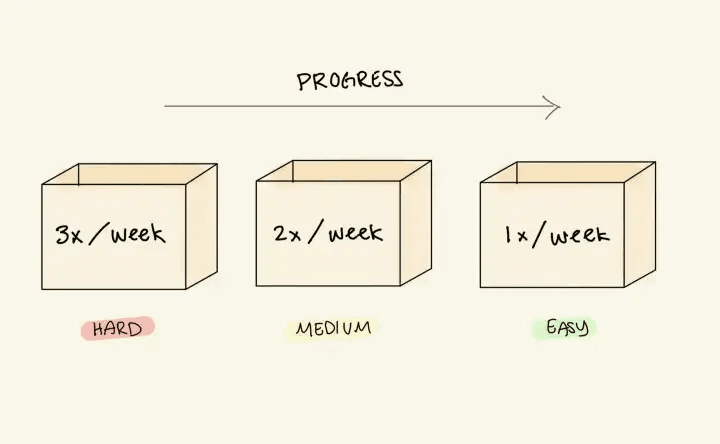
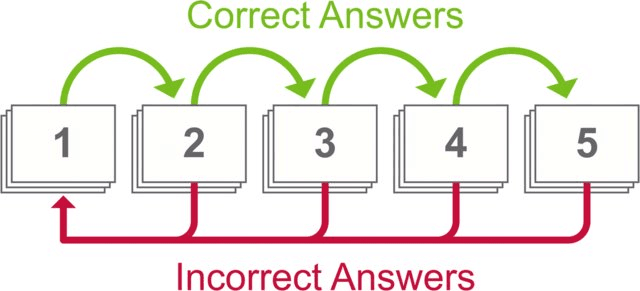
Each card you study begins at the same point, but when you study it the next day, you can sort it into one of the 3 categories based on how easily you were able to recall it.
If you answer a card correctly, it will get ‘promoted’ to an easier category. But if it’s incorrect, it will fall back into the category of being ‘difficult’, so that you can review it more frequently unless you’ve learnt it.
3. Algorithmic Spaced Repetition
Another effective way to learn flashcards is to use digital tools to your advantage.
Certain software algorithms built into flashcard apps assess the user’s performance while they are doing their flashcards. And based on the performance, they adjust the number of days you need in between your next review.
You could say it's a more advanced form of Leitner's system, in which the algorithm adapts review times according to how long it takes you to answer your cards.
Leitner’s, on the other hand, has a fixed schedule that works for the majority of people, but it’s not personalized to your specific learning patterns.
SuperMemo (SM-2) or Free Spaced Repetition Scheduler (FSRS) are two popular algorithms used by flashcard makers like RemNote.
You can make flashcards using RemNote and see the difference for yourself.
4. Interleaving Topics
Interleaving simply means to shuffle your flashcards from different study subjects/topics rather than doing a block of all the cards of a particular topic together.
It forces your brain to actively switch between different concepts and has been shown to improve retention.
A study published in Instructional Science found that students who shuffled their practice problems across different topics scored three times higher on a later test compared to those who practiced one topic at a time.
The problem with doing similar cards in one go is that you’d just learn the order of questions. And when the same topic shows up again and again, your brain won’t have to do the effort we label as active recall.
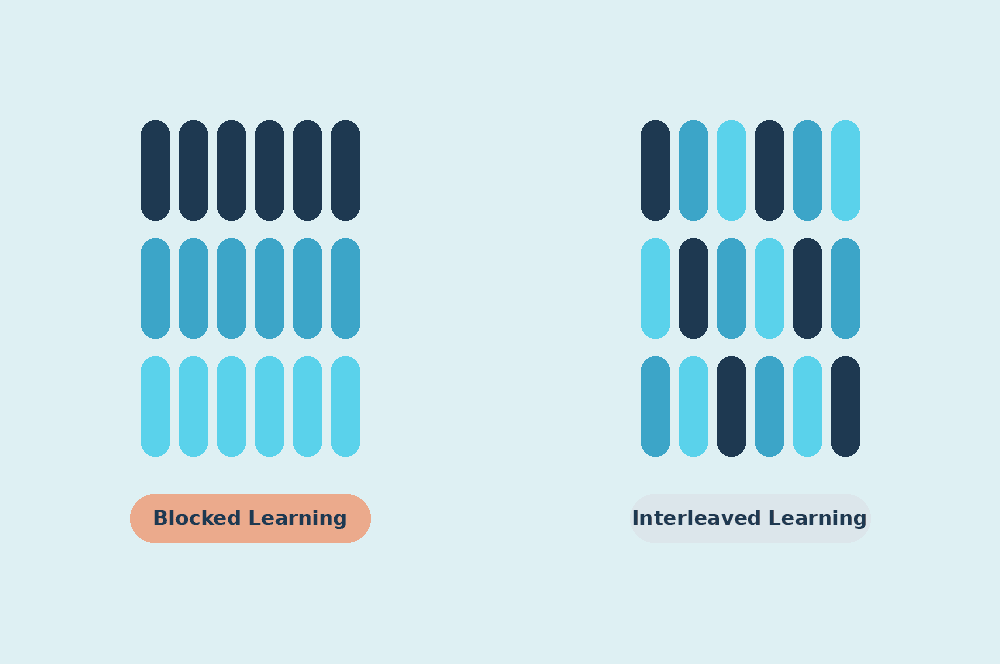
If you use an online tool for flashcards, you can change the settings from seeing new cards in order to ‘at random.’
With physical flashcards, try color-coding decks for different topics so that you can mix cards from each deck during your study session.
5. Combining Images and Words
A whopping 65% of people in the world are visual learners. If your flashcards are text-heavy, chances are, you’ll get bored with them far too quickly.
Try to prevent learning fatigue by including visual memory hooks in your cards. Include pictures, images, timelines, flowcharts, concept maps, or anything that will help you remember a particular topic better than just reading through it.
The human brain also has an impressive ability to process images you’ve seen for as little as 13 milliseconds!
Even if you somehow forget the text on your flashcards, the images you’ve added to them will jog your memory until you can recall it. It’s kind of a backup!
Plus, we all know how dreadful it would be to sit through hundreds of text-heavy cards. The ones with pictures are generally easier to get done with.
6. Using Multiple Question Formats
The more variety you have in your flashcards, the easier it will be for you to get through them. Besides using pictures and images in your cards, you could also add variety by mixing up the different types of formats. Use:
- Basic question/answer format for definitions, key facts, terms, and short explanations
- Fill-in-the-blank or cloze deletions
- Reverse cards, or bidirectional recall, to test important concepts in both ways, e.g., Card 1 (Front: Term, Back: Definition) and Card 2 (Front: Definition, Back: Term)
- Labeled diagrams where specific labels are hidden for you to recall
- True/false questions that test your understanding
Multiple choice is not the best format of questions for flashcards because it is easier to choose an answer from an already-present list than to retrieve it entirely from memory. If you’re good at pattern recognition, you’ll get the right answer even if you don’t really learn it.
The 6 Main Flashcard Types In RemNote - Spaced Repetition
7. Personalizing Your Cards
Premade decks of flashcards are available on the internet for almost every university major there is. And they are a great starting point when you’re just learning how to study with flashcards effectively.
However, using them without personalization will reduce some of the cognitive benefits that make flashcards effective in the first place.
Science says that you remember information best when you generate it yourself rather than simply reading it passively. This is known as the generation effect.
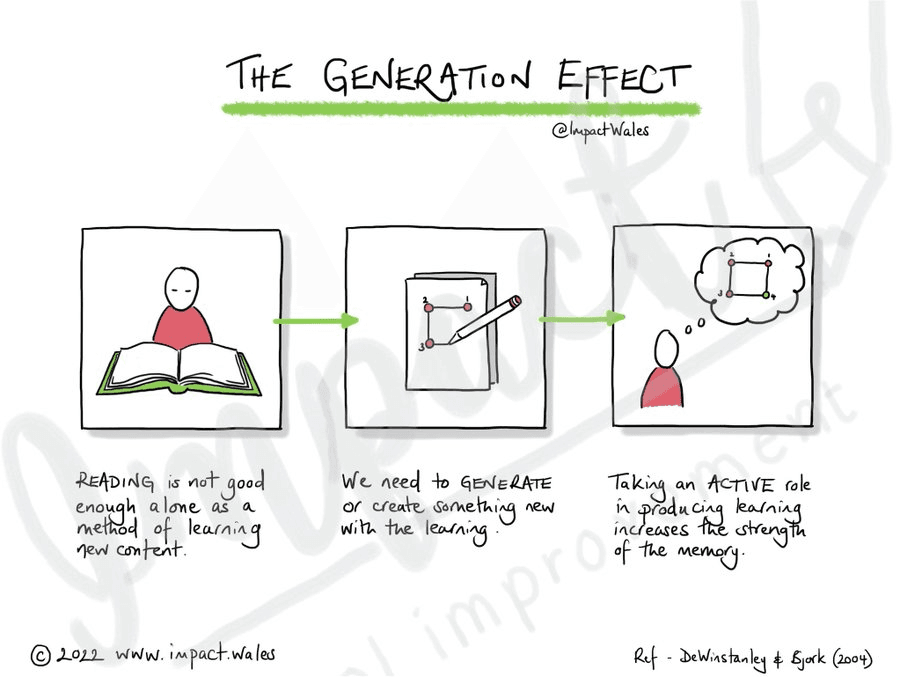
Create your own flashcards with examples you can think of yourself, images that trigger your memory, silly mnemonics you can think of, and you will form much stronger neural connections.
If you’re short on time to create your own cards, you can customize a premade deck. For example, edit some words to match the card with how you think of a concept, and add your own memory hooks.
What NOT To Do When Studying From Flashcards
Now that you understand how to study with flashcards effectively with the tips discussed above, it is equally important to know what NOT to do with your cards.
Here are some mistakes students often make when learning from flashcards. Make sure you don’t make these mistakes to make the most out of learning with flashcards.
Do Not Overload Cards With Too Much Information
You do not want your cards to be overwhelming for you to study. The simpler the cards, the easier it will be to study them and the more likely you are to complete your daily goal. Otherwise, you’ll dread doing them every day.
Overloading cards with too much info also messes with your brain’s ability to recall. Your working memory has a limited capacity, and when you put multiple concepts within one card, you force it to process several pieces of information at once.
It will also affect your scheduling for spaced repetition. With cards having multiple components, there’s a possibility that you remember some parts better than others.
And if you forget only one of them, you’ll have to review the card again. As a result, some information on the card will be over-reviewed.
Do Not Memorize Without Understanding the Concepts
Flashcards are really, really effective for learning, to a point they may do more harm than good!
If you regularly study your cards, you WILL learn the material tested in it, there’s no doubt about it.
But if you don’t understand the core concept well enough, that memorization will be fragile on its own. You will only know the exact phrasing that is easily remembered during your reviews, but if the same concept is tested through a differently worded question, you will struggle big time.
And most of the academic work in university years is application-based. You must know how to apply your knowledge in real-world contexts.
If someone memorizes material through cards without a thorough understanding, they won’t be able to use their knowledge in application-based questions.
Do Not Review Without Spacing
The working principle of using flashcards for studying is to try to retrieve information after some forgetting has occurred.
Human brains have a natural forgetting curve that follows an exponential pattern. You tend to forget 50% of any information you take in within an hour, 70% of it within 24 hours, and up to 90% of it within a week.
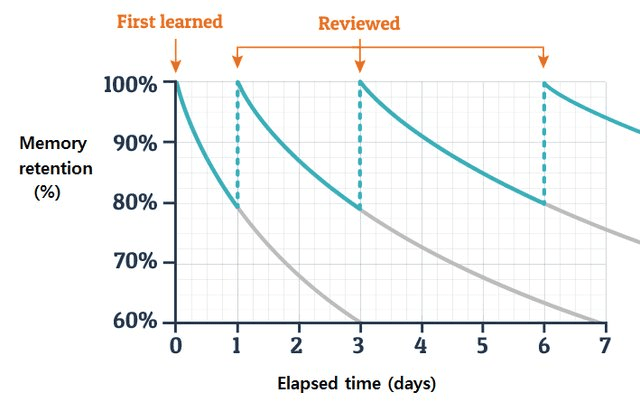
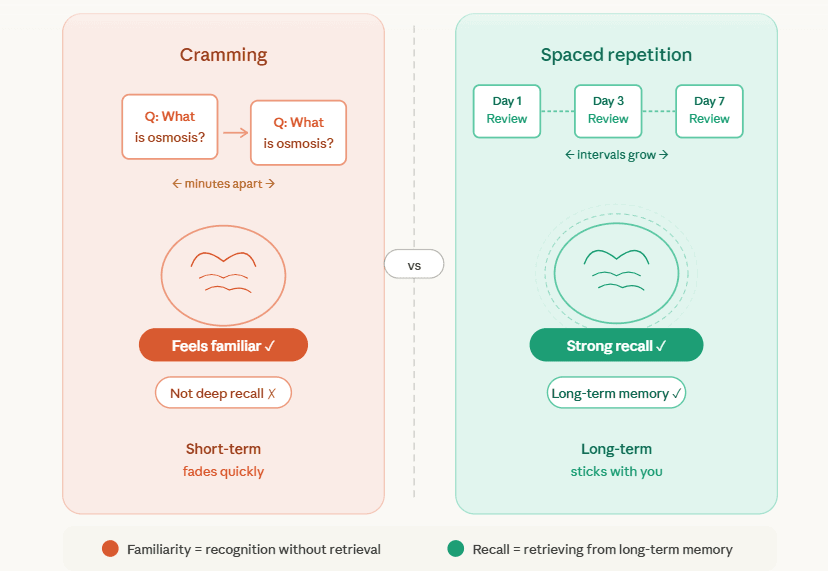
When a card is reviewed repeatedly in a short time, it is still there in your active memory. You’re not really giving it time to go into long-term memory. The info will feel familiar to you, but familiarity is not the same as recall.
We ideally want to space out reviews so that they can form the neural connections of long-term memory.
Study Smart With Flashcards Incorporated Into a Complete Learning System
Flashcards are most effective when they are used as part of a broader study system rather than as a standalone study resource.
You obviously can’t use them to understand new concepts. They will only supplement your understanding so that it’s easy to recall the right info at the right time.
There are dozens of useful note taking or study apps available online that you can use to build your own learning system. And if you want everything consolidated in one place, i.e., notes, flashcards, PDF annotation, and advanced AI study tools, you should definitely check out RemNote.
It combines the functionality of Notion, Anki, GoodNotes, MS Office, and many other tools in one complete system powered by AI, so that you don’t have to juggle between multiple tools. RemNote can also personalize it all for you.
Try RemNote today for free and see the difference in your performance yourself!