
Early Decision vs. Regular Decision: Pros, Cons & Tips


“The admissions advantage gained by applying early is larger at some colleges. Among the 15 undergraduate institutions where early applicants had the biggest edge, the average difference between early and regular admission rates was about 33 percentage points.”
This was reported by U.S. News based on the data from the 2024-25 admissions cycle.
What this means is that early decision applications have a higher acceptance rate compared to regular decision applications.
That changes how you should think about which application route to use.
This article covers both application types in detail. You will also learn about their pros and cons along with some edge cases.
What is early decision?
Early decision is a way of applying to a college that makes it compulsory for you to attend that college in case you get accepted.
Because this is such a major promise, you have to sign an Early Decision Agreement form which your parents and your high school counselor also have to sign.
After this agreement, you are officially committed to attending that college if it sends you an acceptance letter.
The agreement outlines a bunch of rules. One of the biggest rules is that you can only have one Early Decision application active at any given time.
In other words, you can only apply to one college this way. Violating this rule by applying to multiple colleges could get your offer rescinded if the colleges find out.
The deadlines of Early Decision applications come quite early in your senior year, usually around November 1 or November 15.
You’ll find out if you made it or not by mid-December.
If the news is good and you are admitted, you have to quickly withdraw any other applications you sent to other colleges. You also have to pay your enrollment deposit within a few weeks.
But if the school rejects you or decides to defer your application to the regular pool, you are no longer bound by that commitment.
At that point, you are free to apply to other colleges or even try for a different school that offers a second round of early applications.
What is regular decision?
Regular Decision is the traditional way of applying to colleges that doesn’t involve any commitment to a specific college.
You can apply to as many colleges as you want and then choose to attend any of the ones that accept your application.
Their deadlines also come in January or sometimes February, so there’s more breathing room compared to Early Decision applications.
Most of the time, you’ll get a response to these applications late March or early April.
That’s a long time to wait. But the benefit is that you will have all the acceptance letters at once.
You then have until May 1 to decide the college you want to attend. You will have to pay your deposit and officially say yes by this date.
Regular Decision applications are the most common way people apply to colleges. Therefore, the applicant pool is much larger compared to Early Decision, which means the competition is just as tough.
Pros and cons of early decision
Early Decision is a serious commitment. Therefore, you need to weigh its benefits against the potential cons before choosing this route.
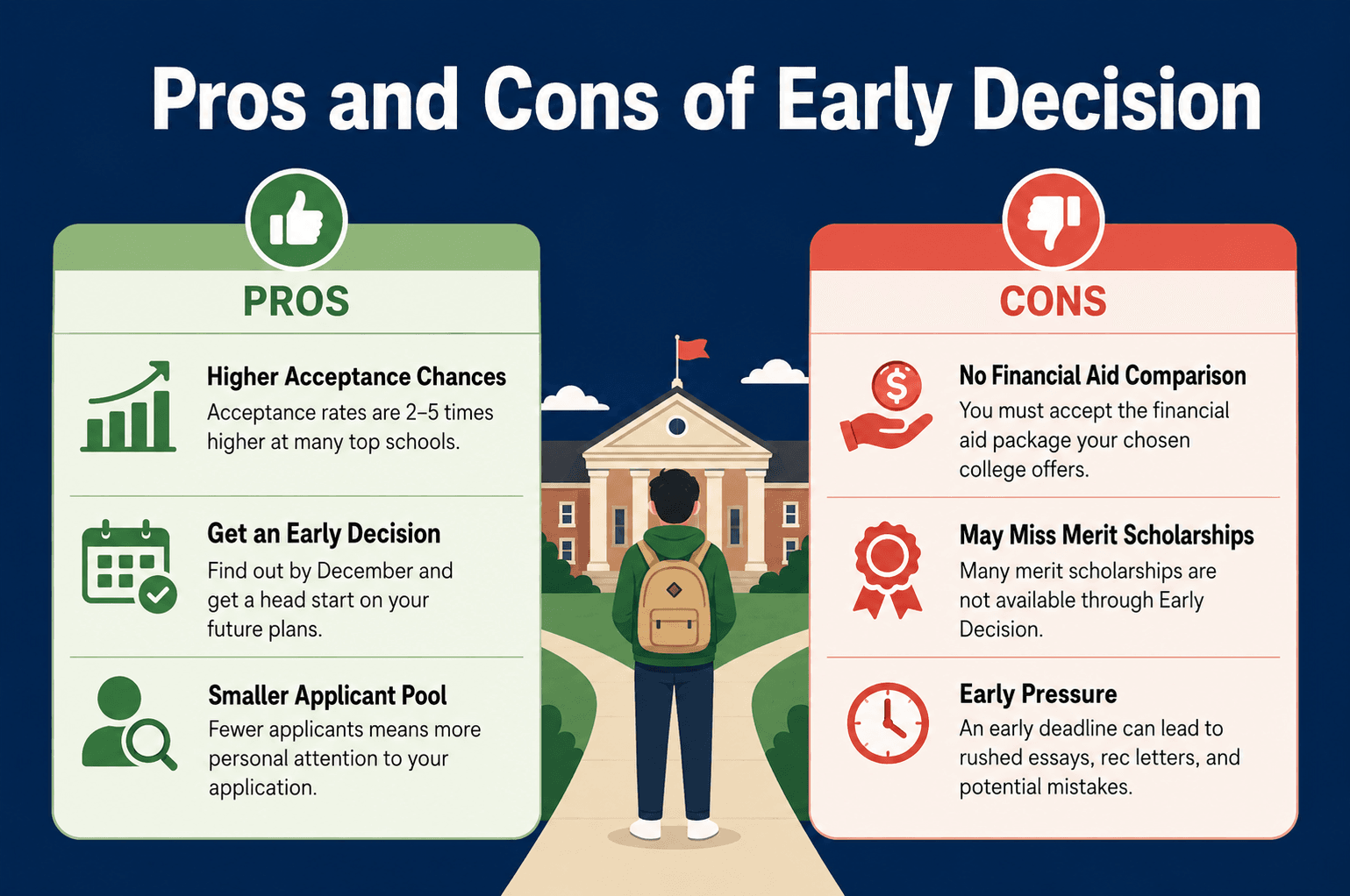
Pros
- At some of the most selective schools in the country, acceptance rates for Early Decision applications are two to five times higher compared to Regular Decision applications. That’s because an Early Decision applicant is more likely to attend upon being accepted compared to a Regular Decision applicant. This makes colleges value the former more.
- A massive portion of the seats is filled with Early Decision applicants before regular applicants are entertained.
- The search for a college ends by December, and you have extra time to take care of other things like deciding your future roommate, what you want to major in, student visas, travel arrangements, etc.
- The applicant pool is much smaller because less students go the Early Decision route. Your application will have a better chance of being carefully reviewed by the admissions staff.
Cons
At the same time, there are some pretty big downsides that you should keep in mind.
- Early Decision applicants lose the ability to compare financial aid offers. You have to do with whatever financial aid the college that you chose offers.
- You might miss out on merit scholarships because most schools that offer merit scholarships don’t use the Early Decision system.
- Because the deadline of Early Decision hits so early in your senior year, you might feel pressured to rush through your essays and letters of recommendation. A rushed application often contains silly mistakes or inconsistencies that could make you look careless to admissions officers.
- You have to apply with the grades you earned through your junior year. If you had a rough start in high school, applying early might be a disadvantage for you, even if you’re hoping to get higher grades in your senior year.
- You cannot have second thoughts about the campus culture or the specific location once you have applied early for a college.
- The pool is very competitive despite being small because it is usually filled with the most high-achieving and well-prepared students.
- If a college accepts your application and you refuse to attend, the college may share the list of such students, and your high school might even refuse to send your final transcripts to other colleges.
How early decision affects your financial aid
As you know, choosing to apply through Early Decision means you won’t be able to compare financial aid offers from different schools.
You have to accept whatever financial aid package the school you are committed to decides to offer you.
You cannot negotiate this package to ask for more money either because the school knows you have no leverage and you have promised to attend.
To avoid being stuck with financial aid that you are not going to like, you should use the net price calculator on the college website before applying to get an estimate of what your family will have to pay out of pocket.
However, there’s an edge case that can get you out of the agreement if your family cannot afford the expenses of a college.
And that is if it is truly impossible for your family to afford the college with the financial aid package they offer. In this case, most colleges will allow you to break the commitment and walk away.
But you should also keep in mind that this is often a difficult and stressful process. The admissions office might ask for a lot of proof regarding your financial situation before they agree to release you.
Scenarios when you can withdraw from early decision
Life is unpredictable, and situations can get out of your hands. That’s why there are a few scenarios when colleges allow you to walk away from the Early Decision agreement.
- The most common reason is the lack of financial aid that we just discussed earlier. This reason for withdrawing from the contract can be invoked when the financial aid the college offers does not make the degree affordable for your family. But before you give up due to this reason, you should always talk to the financial aid office about finding a bit more scholarship money or grants to help you out. If that doesn’t work out, colleges typically let you go because they do not want to force a student into a financial crisis.
- Another scenario when you become eligible to leave the contract is when there’s a major emergency like a serious family illness or a death in the family. In these situations, make sure to explain the situation honestly to the admissions officers as soon as you can. Some colleges might even suggest that you take a gap year and join the next class.
These were the primary reasons that allow a student to initiate a withdrawal from the agreement.
But there is one other common scenario where the contract simply expires on its own.
That happens when the college decides to defer your application to the regular decision pool. This releases you from the binding promise by default. When this happens, you can apply to other colleges or even another school through a second round of early applications without any penalty.
There are also some very specific institutional policies which can release you from the early decision agreement.
For example, Reed College and some other private colleges have started allowing students to request the disclosure of their financial aid packages before they get a response on their application.
If, after previewing the financial aid package, the offer doesn’t look feasible, they can be released from the agreement or moved to the regular pool with no penalty at all.
Besides these scenarios, the agreement is strictly binding in any other situation.
Pros and cons of regular decision
Regular decision application is the most flexible, and therefore it has more benefits than downsides.
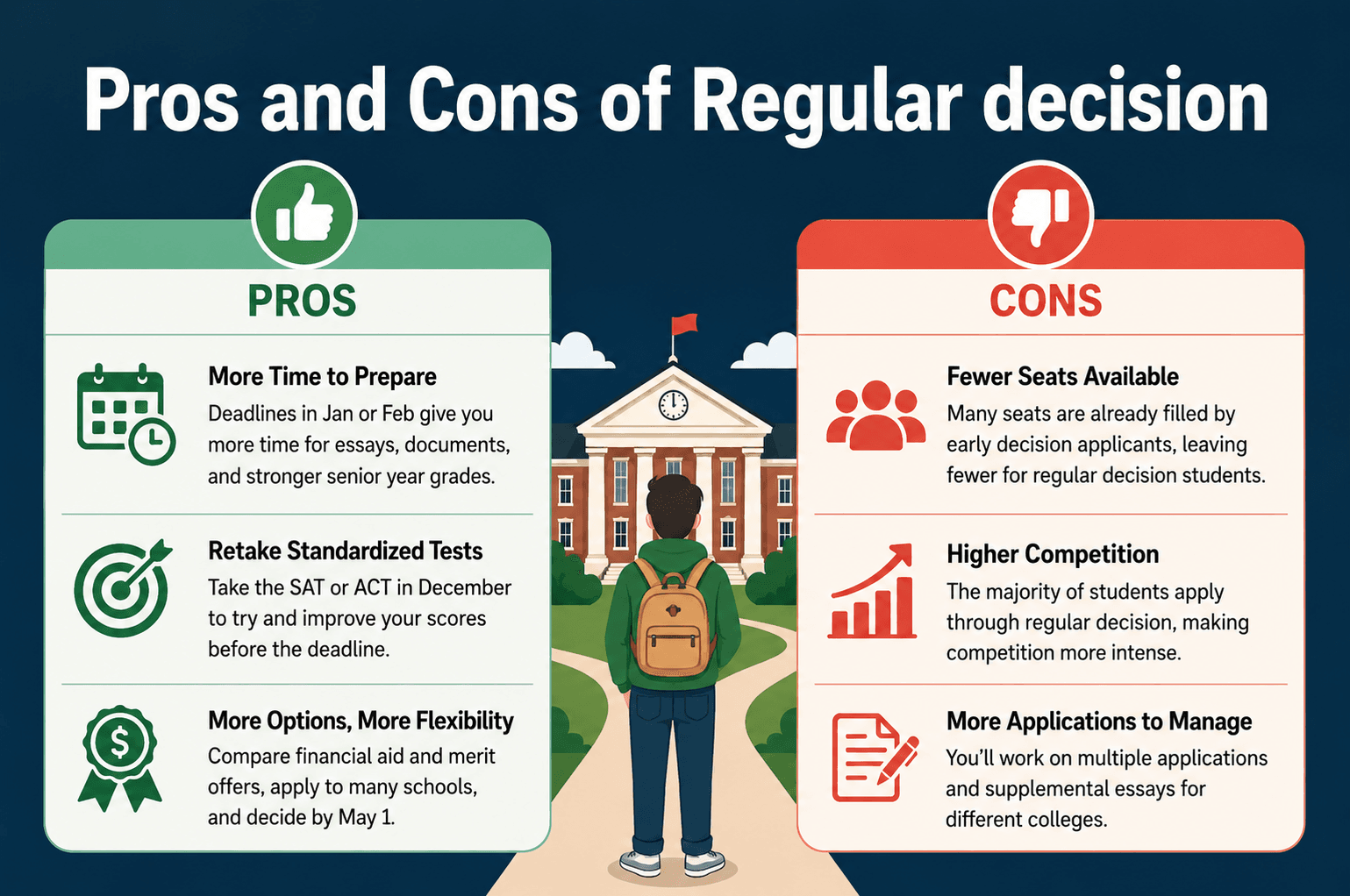
Pros
- The deadlines of regular decision applications usually come in January or February, which means you have a much bigger window to finish your essays and gather your documents.
- The extra time also means you’ll have your first semester senior year grades to include with your application.
- You can take the SAT or ACT one last time in December to try and bump up your scores before the final application deadline.
- The biggest benefit for many families is the ability to compare several different financial aid and merit scholarship offers from different schools at the same time and choose the most budget-friendly option.
- You can apply to as many colleges as you want.
- You have until May 1 to make the final choice, which gives you more time to visit campuses and talk to current students to make sure the school is a good fit for you socially and academically before you say yes.
Cons
- Many seats in the freshman class have already been given to early decision applicants before colleges start reviewing regular decision applications. This leaves a lot fewer seats for regular decision students.
- The vast majority of students from across the country apply through regular decisions, which makes the competition much more intense for a smaller number of seats.
- You have to work on multiple applications and supplemental essays because you are applying to multiple colleges.
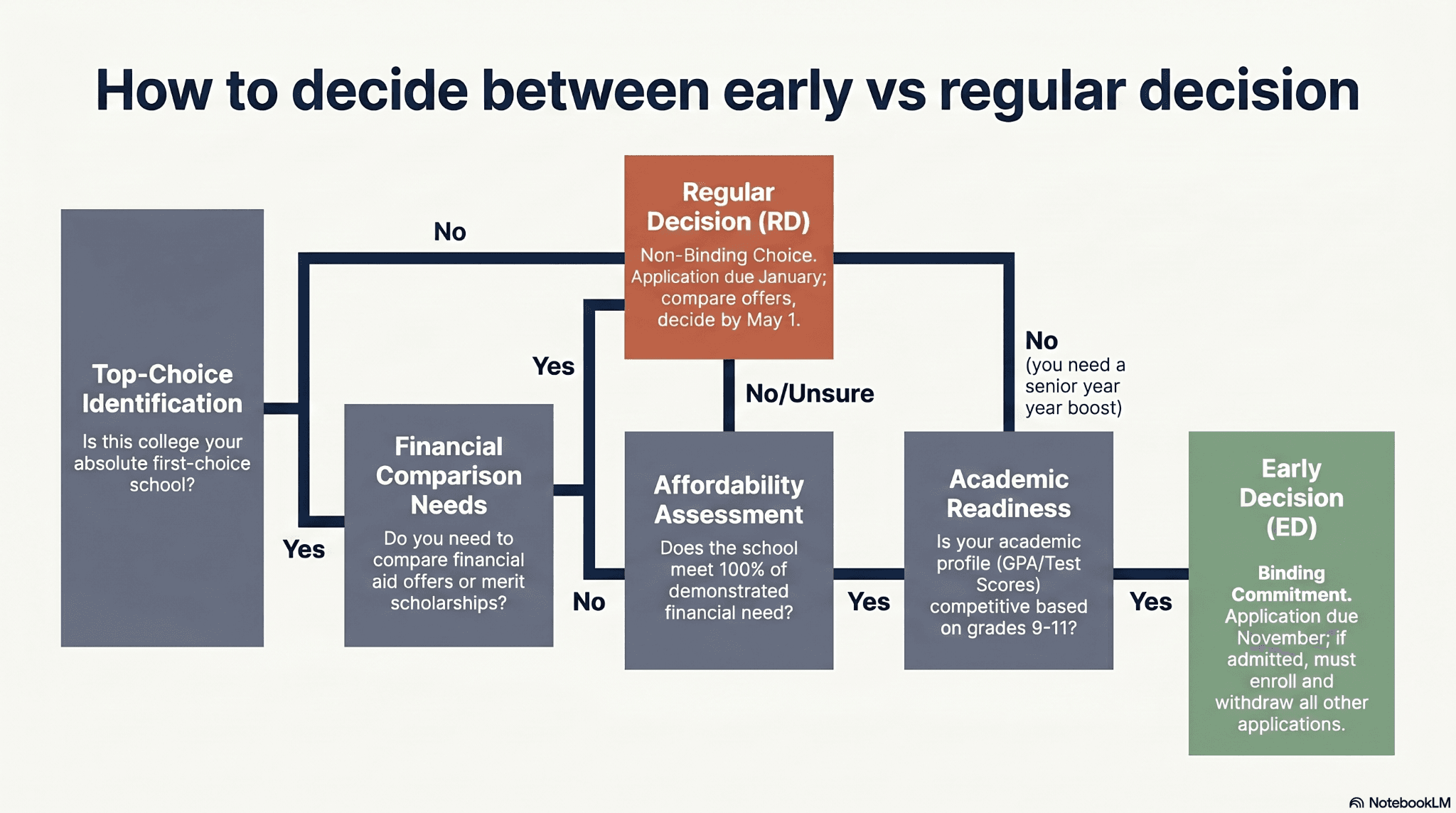
Decision matrix: how to decide between early vs regular decision
Before you even choose an application type, you need to make sure you are the right fit for it.
And for that, you will have to consider a few factors.
The very first question you should ask yourself is: do you have a college in mind that you have always wanted to attend?
Because if you don’t have a specific preference, then there’s no need to bind yourself to a single random college. You can simply apply through Regular Decision.
But if you have a dream college, then you may rule out the Regular Decision option at this stage. Applying early is for the student who has done all the research and knows without a single doubt that this is their number one home for the next four years.
The next thing you should consider is whether the financial aid offer can make a college unaffordable for you. If it can, then you will have to choose Regular Decision because that’s the only option out of the two where you have multiple financial aid packages to choose from.
If you don’t need to compare offers or you’re sure the college you’ve chosen will offer a feasible financial-aid package, then an early decision can be considered.
Your transcript and your current test scores are also important factors to consider.
Early decision has tougher competition because the pool typically includes high-achieving students. So if you want to apply through early decision, you better have above-average scores.
If your junior year grades aren’t attractive, avoid applying through Early Decision. Wait for the grades from the senior year to come out, by which time the Regular Decision application rounds would have started.
Have RemNote flashcards by your side for better grades
Both regular decision and early decision applicants get their grades reviewed by colleges.
To stand out in your pool, your grades need to be strong. And good grades come from studying the right way.
RemNote is a note-taking and flashcard generation app that can help students memorize information for a long time.
You can create flashcards from your notes in real-time, or you can upload lecture files, YouTube videos, PDFs, and other materials and let RemNote generate flashcards from them.
After creating flashcards, RemNote also organizes them based on which ones you know the best. This all happens automatically.

