
Note-Taking Methods Compared: Cornell vs Outline vs Mapping

When Japanese researcher Keiichi Kobayashi pooled 57 studies comparing students who took notes during lectures with students who only listened, note-taking came out ahead. But the advantage was surprisingly small.
However, the research showed a dramatic leap when students organized notes for active memory retrieval, providing more than triple the memory boost for active recall than for passive recognition.
In other words, just writing things down isn't enough. How you organize your notes, and what you do with them afterward, matters more.
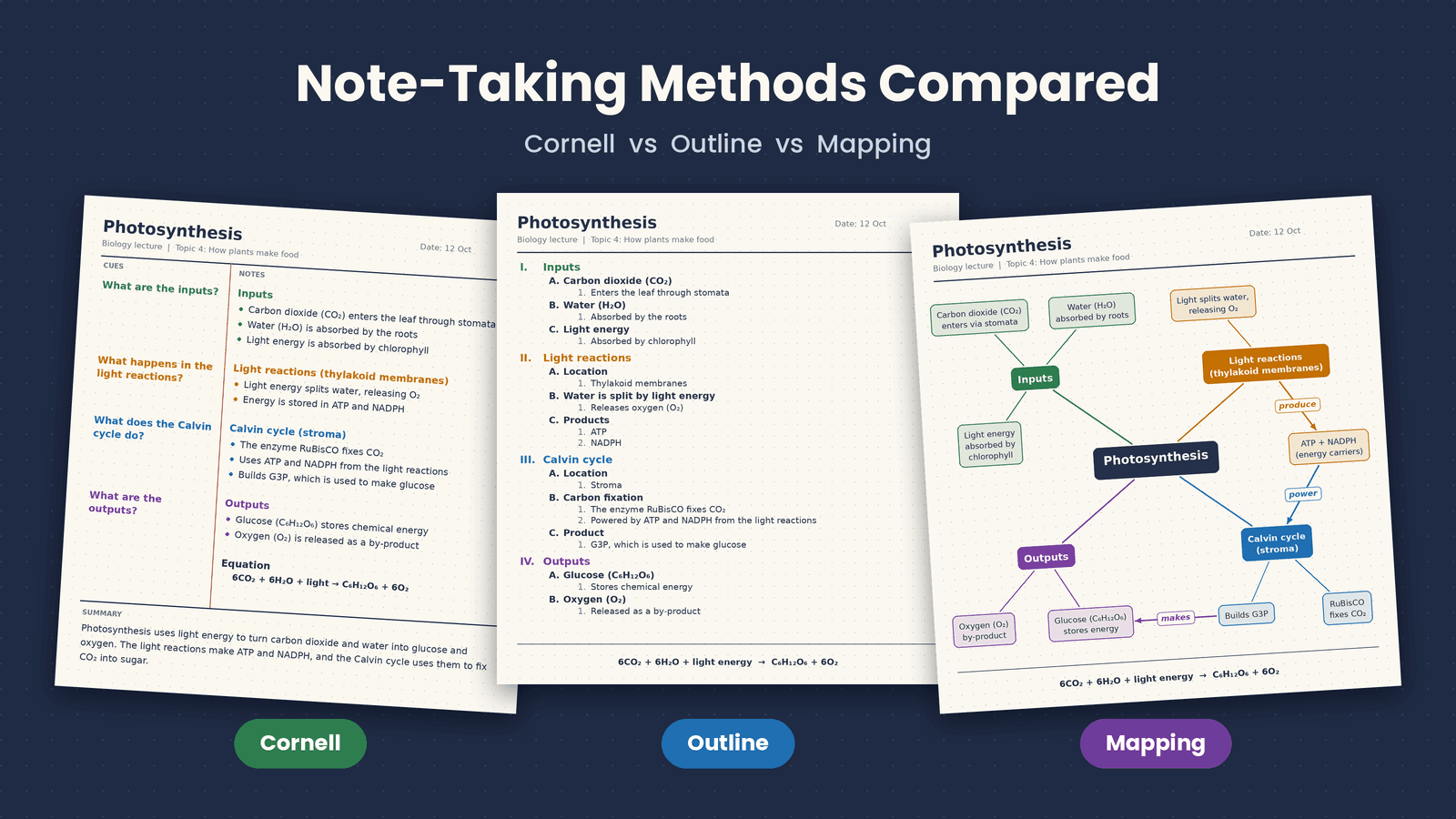
This article compares the three most commonly taught note-taking methods, namely, Cornell notes, outlining, and mapping. You'll see how each one works, where they work best, where they fall short, and how all three look when applied to a sample photosynthesis lecture.
TL;DR
The 3 common note-taking methods are:
- Cornell notes, which contain built-in self-testing, best for exam review
- Outline notes for hierarchy-based structured lectures
- Mapping notes, which create visual connections for complex topics.
Each of these methods should be paired with an active recall review method to retain the content. Many students use a combination of note-taking methods based on different subjects they are taking notes for.
What Are Note-Taking Methods?
A note-taking method refers to a structured, repeatable system you can use to organize any information you learn to review it later. You take notes during a class based on what your instructor prioritizes in the lecture.
There are 5 common types of note-taking methods:
- Cornell (a specific format of notes, keywords, and summary)
- Outline (organizing notes into a hierarchical structure using headings and indentations)
- Mapping (a visual method with a central idea and multiple branching subtopics)
- Charting (organizing lecture information into tables for easier review)
- Sentence (writing down every single fact as a separate sentence of its own)
We will look at the first three types in extensive detail because they are most widely taught in schools.
Each of these works best for a different kind of material. Cornell notes suit fact-heavy lectures you'll need to review for exams, the outline method suits lectures with a clear structure of topics and subtopics, and mapping suits topics with lots of interconnected ideas.
Let’s explore these methods in more detail.
Note-Taking Methods Compared: Cornell vs Outline vs Mapping
Here’s a quick comparison of the 3 popular note-taking methods in terms of what they work best for and how they help you learn course content:
| Method | Cornell | Outline | Mapping |
| Best for | Fact-heavy lectures | Typed notes | Interconnected topics |
| Best subjects | Biology, history, law | History, literature, business | Biology, biochemistry, economics, literature, medicine |
| Effort in class | Medium (key points only) | Low (quick bullet points) | High (you need to think before linking topics) |
| How you review it | Cover the notes section, use the cues column for active recall | Can turn each bullet into a question to answer from memory | Redraw the map from your memory and compare it against the original |
| Weak spot | Need to go back to notes after lecture to fill in cues | Rigid format, does not allow linking related concepts | Difficult to make, can get messy |
| Easy to turn into flashcards? | Yes | Partly | No |
Now, let’s look at each of them in detail.
The Cornell Method
The Cornell method for note-taking was first introduced in the 1950s by Cornell University education professor Walter Pauk. He later described its structure in his book, How to Study in College (10th ed.), published in 2010.
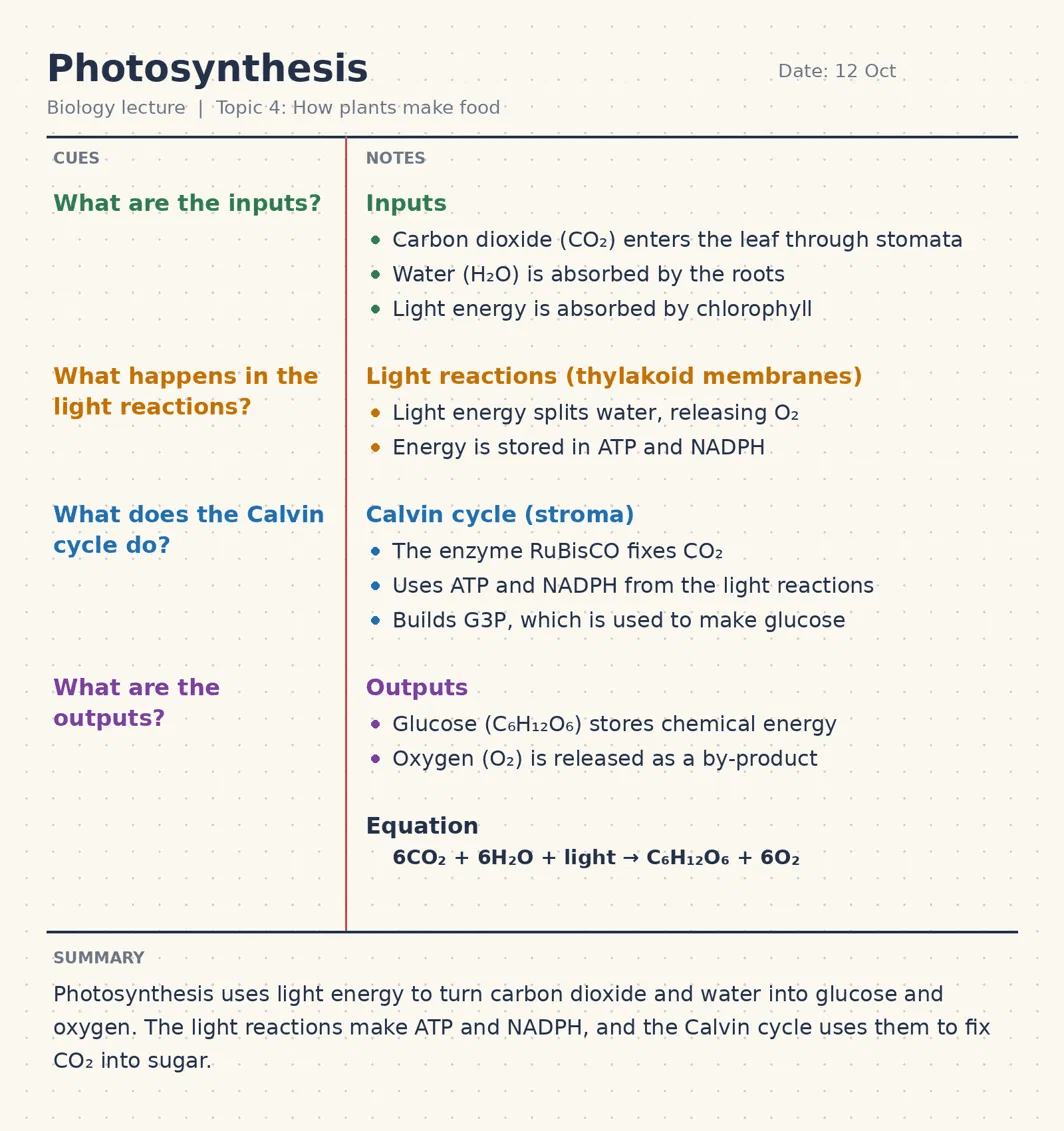
Cornell notes divide your page into 3 parts:
- A cue column on the left side of the page, about 2.5 inches wide
- A large notes area on the right, at least 6 inches wide
- A summary section at the bottom of the page
The recommended method for taking notes in the Cornell template is to write important points in the notes area during your lecture, add cue questions and keywords after class to review later, and include a 2–3 sentence summary for a quick refresher on the topic.
When reviewing, you cover the notes area and use the cue column to recall what you learned. Research supports active recall as a way to improve content retention.
The Learning Strategies Center at Cornell University has a dedicated module where you can learn how to take effective Cornell notes.
Best For
The Cornell note-taking system works best for fact-heavy lectures like biology, history, law, etc., with minimal visual requirements. It’s great for students who need an active-recall review system alongside their notes.
Limitations
You will have to go back to your notes after the class ends to fill in the cues column. Otherwise, it will stay empty. Some people find the Cornell layout too rigid for certain lectures involving diagrams and flowcharts, like note-taking for chemistry reactions.
Cornell Notes Example
Here’s an example of using the Cornell note-taking method for a sample photosynthesis lecture:
The Outline Method
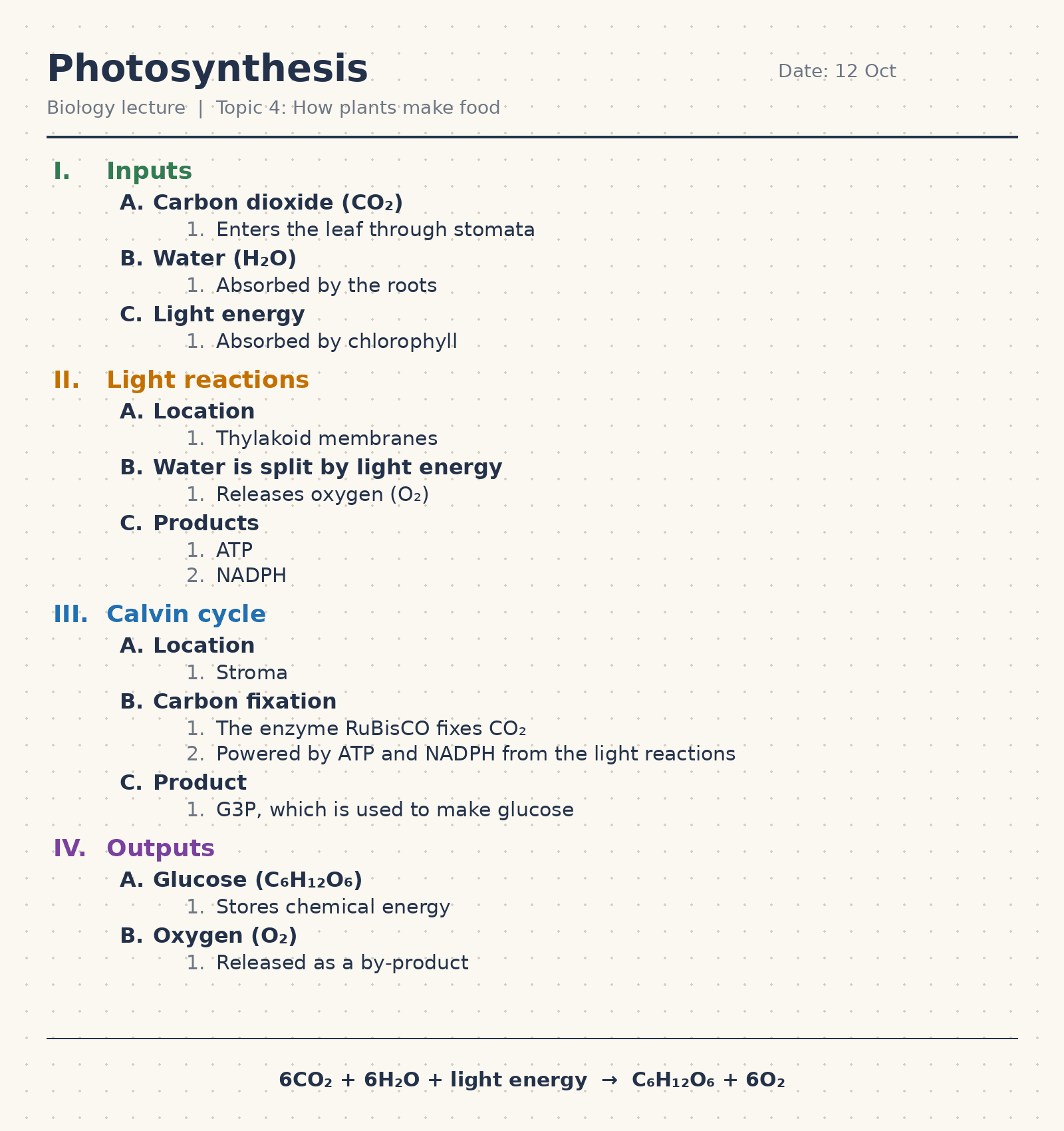
This is a hierarchical note-taking method in which you begin with the main topic on the left and add all supporting details indented underneath, level by level. The outlines can be:
- Indented as bullets or dashes without labels)
- Formally formatted in Roman numerals, letters, numbers, etc.
Most students take notes digitally as they type, so they use the outline method because every notes app supports bullets. If you want to review these notes, you can turn each main heading into a question to answer from memory the next time you see it.
Best For
The outline method works best for digital, easy-to-scan note-taking, especially for subjects that require an organized, clear structure, like history, literature, and business courses.
Limitations
The problem with the outline method is that you can’t link interrelated concepts. It is hard to keep up when a lecture jumps between topics, and you can’t seem to organize it well.
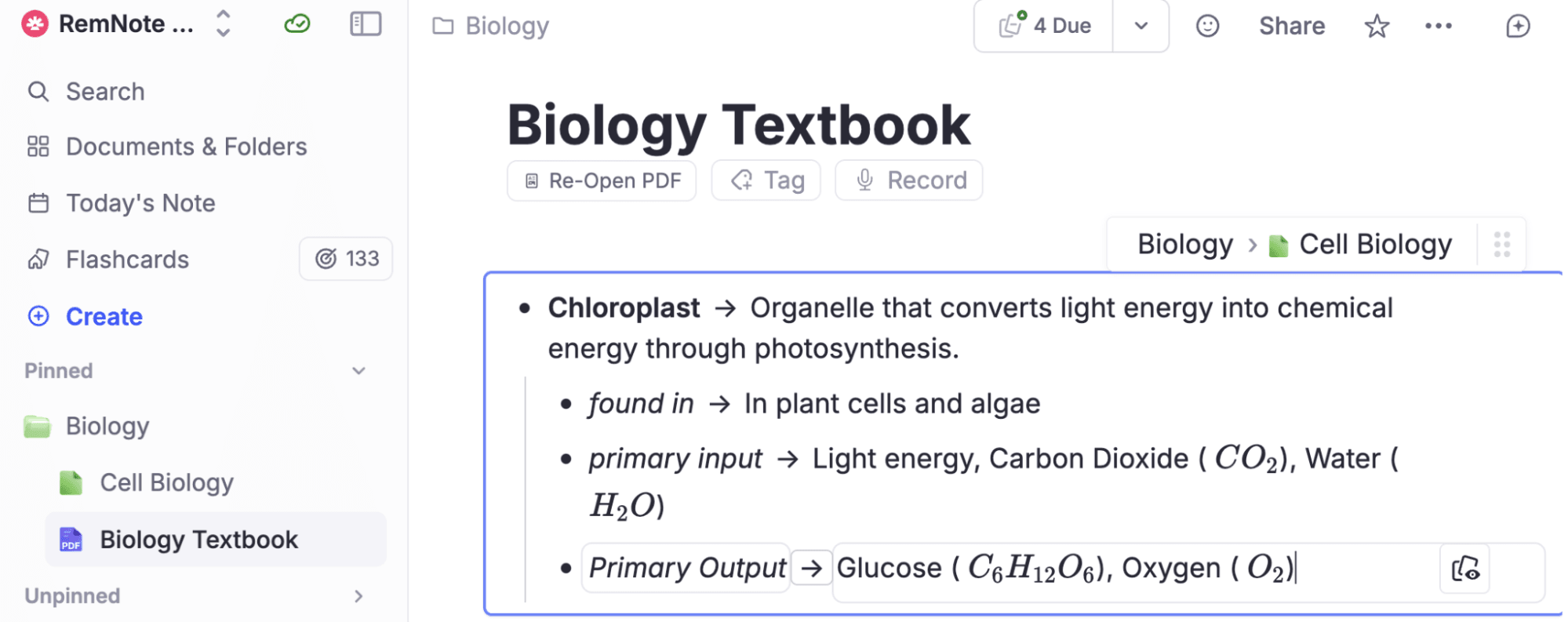
That said, some note-taking apps now solve this problem. For example, in RemNote, every bullet in your outline is its own building block, called a Rem. You can link any bullet to a related concept anywhere else in your notes by typing [[ and choosing it. That's called a Rem Reference.
RemNote automatically adds a link in the other direction too, so when you open a concept like "ATP," you can see every lecture where it came up. And if one idea belongs under two topics, a portal lets the same bullet appear in both outlines without copying it.
Some students also fall into the trap of typing lecture notes word-for-word, which often leads to weaker understanding of the topic.
Outline Notes Example
Look at the following example of the same photosynthesis lecture in the form of outline notes:
The Mapping Method
Mapping is a visual note-taking method in which you place the main topic in the center, then branch out subtopics connecting them to each other via arrows. It comes from the Novak & Cañas concept map theory that states you tend to learn better by actively anchoring any new info you learn with your existing knowledge base.
There are two types of such maps:
- Mind maps in which the branches spread out from one central idea
- Concept maps that follow a similar structure, but the linking arrows are labeled
Reviewing your maps requires you to draw the map again from memory and compare it against the original.
Best For
Some subjects have inter-related topics that require connecting the ideas to understand the bigger picture. Biology systems, biochemistry, economics, and literature themes are examples of subjects where mapping works well.
Mapping is also very helpful for brainstorming. You can use it to condense an entire unit into a single image.
Limitations
It is difficult to figure out the connections between topics if you are making a map during a fast-paced lecture. Therefore, students like to create them after they have taken their lectures.
Large maps can also get messy really fast. You will have to be deliberate with the spacing to make sure your map holds the definitions and formulas you need to remember.
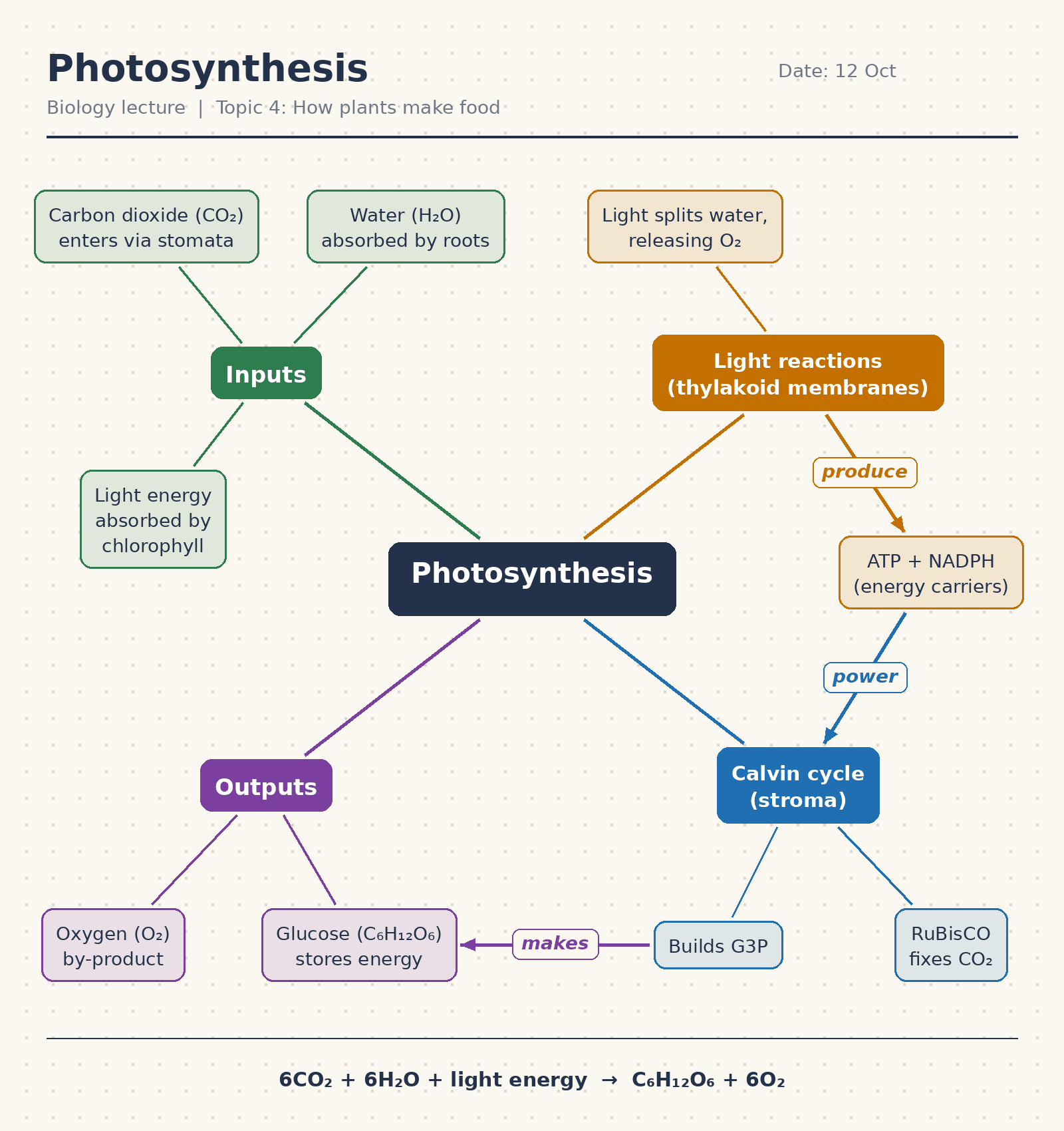
Mapping Notes Example
This example shows photosynthesis notes taken in the mapping method:
Which Tool Can Help You Use These Note-Taking Methods?
Your notes, no matter what method you use to take them, need to be reviewed over and over if you want to retain the information they contain.
Many students tend to skip the review process for different reasons, like the process being manual, time-consuming, and simply because note-taking makes them feel productive enough.
RemNote is a great solution to this problem. It’s a note-taking app that treats your notes and flashcards as one item, i.e., you do not need to create your flashcards separately. It has a built-in spaced repetition system for reviewing the notes.
If you make Cornell notes, RemNote will convert all your cue questions into flashcards right inside your notes. It supports the outline indentation format by default. The tool also allows you to create three different types of mind maps for linking similar concepts on its infinite canvas:
- Structured tree mind maps
- Shape mind maps
- Sketched mind maps
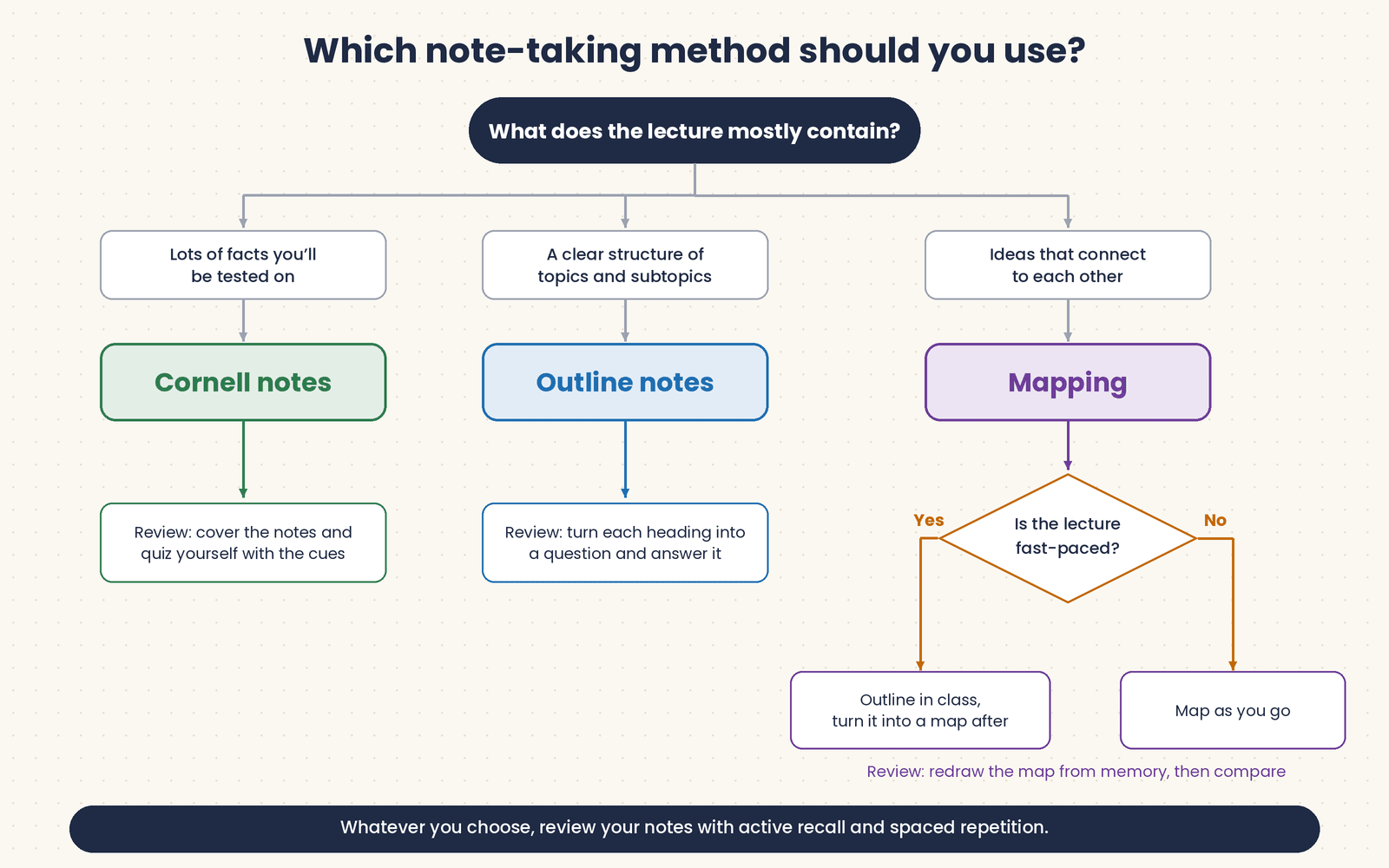
No matter what note-taking methods you prefer, RemNote auto-schedules all your reviews for the flashcards using the SM-2 spaced repetition algorithm by default. There’s also the option to enable the Free Spaced Repetition Scheduler algorithm.
You will remember your notes from day one right until the day you take your exam.
Try RemNote for free today to consolidate your notes and review them in one place!
FAQs
What Are the 5 Note-Taking Methods?
The 5 methods of note-taking are:
- Cornell notes consisting of notes, cues, and summary sections
- Outline notes in which there are bullets and indentations underneath a main topic
- Mapping notes consisting of visual mind maps and concept maps
- Charting notes that display information in the form of tables and flowcharts
- Sentence notes treating every important fact as a separate sentence
What Are the Four Main Types of Note-Taking Methods?
There is no official list of the main types of note-taking methods. However, based on what’s commonly taught to students, popular note-taking methods include Cornell notes, outlining information by hierarchy, mapping concepts to link them, and charting information into tables, images, flowcharts, etc.
What Are the 7 Rules of Note-Taking?
There is no official evidence-based list of 7 rules for note-taking, but some practices are widely recommended to students. For instance, it is advised that you write notes in your own words, focus on key ideas rather than copying all of the lecture word-for-word, use a consistent note-taking method, leave some space to later add any content you miss, review your notes within 24 hours, etc.
What Are Some of the Best Note-Taking Methods?
Different note-taking methods are best suited for different tasks. Cornell notes, for example, work great for students preparing for an exam. Outline notes work well for structured lectures in history or business, and the mapping method is best for understanding links between different topics. No matter the method you use, the best retention comes from active recall and spaced-repetition review.